Every 9-year-old girl looks forward to her next birthday and I was no exception. In our house birthdays were special because we could choose the meal we wanted Mom to make, choose the kind of cake and frosting we wanted her to bake, and could invite a friend or relative for dinner. And, of course, there was a wish to make, candles to blow out, and at least one present.
The year I turned 10, my birthday was on a Saturday. That morning Mom sent me on an errand to Beazel's, the local grocery store two blocks away. On the way, Linda Patterson came out of her house and walked part way with me. Linda and I were in different grades in school and while we were friendly, we didn't spend much time together. She began excitedly talking about birthdays and birthday parties. I knew there was no way she would know it was my birthday so I was surprised at her topic of conversation.
When I returned home from the store, Gramma called and invited me to eat lunch with her and Grampa. Picky me. I wanted to know what they were eating before I accepted the invitation. (She could have served me bread and butter and I would have been thrilled, but if she was making tuna sandwiches and I had to eat them, I wasn't interested.) I think she finally persuaded me to join them when she told me we would drive into Niles after lunch.
In the photo at right you can see what happened when I arrived home after our trip to Niles. Yes, I was surprised!
I can't remember party activities. Perhaps we played Pin the Tail on the Donkey. Maybe my older sister, Marsha, helped. Details have faded from my memory. I'm grateful Mom thought to take photographs.
Here we are with candles lit. Clockwise from front left are Audrey Jenkins, Janet Grubbs, Kathy Ambrose, Harriet Bowser, Marsha Dell, Beverly Bowser, Linda Patterson, Phyllis Bowser, and Marsha Koncsol (with her tongue stuck out). I'm front and center.
Someone was missing in the photo above. Here we are again. Front, left to right: me, Kathy Ambrose, Ann Walter, Linda Patterson, Marsha Koncsol, and Janet Grubbs. Rear, left to right: Beverly Bowser, Audrey Jenkins, Harriet Bowser, Phyllis Bowser, and Marsha Dell.
Notice that we were all wearing dresses, the standard party wear at that time. Pants were for playtime, dresses for school, church, parties, and all other occasions. We looked forward to getting dressed up.
As I remembered and thought about this party, I suddenly realized that it was a hugely
generous gift for my mother to host a birthday party for me. She was
a very private person and was extremely careful and protective about her home.
To have 10 little girls there for a party must have nearly frazzled her
nerves. It's strange that only now am I recognizing the birthday party for the gift it was. Thank you, Mom!
This post is being contributed to 123rd Edition of the Carnival of Genealogy: A Birthday Party! which is hosted by Jasia at Creative Gene. I'm sending thanks to her for hosting the Carnival and happy birthday wishes because she's celebrating her own birthday in November. Thank you, Jasia, and Happy Birthday!
.
Showing posts with label Carnival of Genealogy. Show all posts
Tuesday, October 30, 2012
Wednesday, July 25, 2012
Meinzen Confectionery, Steubenville, Ohio
The oral tradition in our family was that Grampa Henry Meinzen, my maternal great-grandfather, owned a cigar store. My childhood response was, "Oh, yuck." (Of course I couldn't have said that aloud because it would have been disrespectful.)
Decades later, I was pleasantly surprised to find Henry in Steubenville city directories. In the 1904, 1906, 1911, and 1913 directories he was listed as a confectioner with a store at 308 South Third Avenue, next door to his residence. In the 1915-1916 Steubenville City Directory, he was listed as a grocer, but in 1918 he was again listed as a confectioner. A candy store!
I suppose it was easier on the adults to tell the children it was a cigar store instead of candy store: I loved candy and would have been a pest to learn what kind of candy he sold and how much it cost. But knowing he owned a candy store would have endeared him to me.
My father was a child of candy-buying age just a few years later. He remembered that a penny's worth of candy was enough to make him sick. My eyes would have sparkled at the idea of buying so much candy for a penny.
From the photograph above it's difficult to tell exactly what's in the cases. I think there are boxes which look about the size of our modern-day cigar boxes. And I see jars on a higher shelf behind that counter that look like they could have candy in them. It's possible that he sold both cigars and confections.
As far as I've been able to learn, Henry's last year as a shop owner was 1918. Perhaps the combination of age and illness caused him to close the shop. He was 79 in 1918, and his wife, Elizabeth, had already been diagnosed with cancer of the face.
Henry was born 176 years ago, on July 25, 1827. This post honors his memory. Happy birthday, Grampa!
This post is also a contribution to the Carnival of Genealogy: Business and Commerce. Thank you to Jasia of Creative Gene for hosting the Carnival. You can find links to all the submissions at her blog sometime after the first week of August.
.
Decades later, I was pleasantly surprised to find Henry in Steubenville city directories. In the 1904, 1906, 1911, and 1913 directories he was listed as a confectioner with a store at 308 South Third Avenue, next door to his residence. In the 1915-1916 Steubenville City Directory, he was listed as a grocer, but in 1918 he was again listed as a confectioner. A candy store!I suppose it was easier on the adults to tell the children it was a cigar store instead of candy store: I loved candy and would have been a pest to learn what kind of candy he sold and how much it cost. But knowing he owned a candy store would have endeared him to me.
My father was a child of candy-buying age just a few years later. He remembered that a penny's worth of candy was enough to make him sick. My eyes would have sparkled at the idea of buying so much candy for a penny.
From the photograph above it's difficult to tell exactly what's in the cases. I think there are boxes which look about the size of our modern-day cigar boxes. And I see jars on a higher shelf behind that counter that look like they could have candy in them. It's possible that he sold both cigars and confections.As far as I've been able to learn, Henry's last year as a shop owner was 1918. Perhaps the combination of age and illness caused him to close the shop. He was 79 in 1918, and his wife, Elizabeth, had already been diagnosed with cancer of the face.
Henry was born 176 years ago, on July 25, 1827. This post honors his memory. Happy birthday, Grampa!
This post is also a contribution to the Carnival of Genealogy: Business and Commerce. Thank you to Jasia of Creative Gene for hosting the Carnival. You can find links to all the submissions at her blog sometime after the first week of August.
.
Saturday, March 31, 2012
A Biography from the Heart: Emma Bickerstaff Meinzen
During most days of my childhood and youth I spent time with my grandmother, Emma Virginia Bickerstaff Meinzen. She lived two doors and one large yard away on our street in the village of Mineral Ridge. My mom watched me from our doorway when, at age five or six, I walked down the street alone to Gramma's. Through grade school I spent as much time in her company as my parents would allow.Gramma taught me how to crochet granny squares and how to cut and hand stitch Dresden Plate quilt blocks. She answered my questions about baking and cooking while she made dinner, measured a cake, or mixed and rolled out pie dough. She treated me to Vienna bread and real butter after school. (Our own house was an oleo-only house. Eating real butter was almost as good as eating chocolate.) I watched her sew, helped her hang laundry outside on the clotheslines on summer Mondays, and we picked strawberries on June mornings then toted them home and made jam and fresh strawberry pie.
Grampa was a barber. To keep the costs down, Gramma used a wringer washer to wash the towels Grampa used in his barber shop (though my mom and aunt have said that she washed them by hand before she had a wringer washer). When her youngest daughter graduated from high school and chose to go to college, Gramma worked in a bakery to help pay for her tuition.
Gramma never had a driver's license: someone else drove when she needed to go anywhere. If the driver was my grandfather, she frequently reminded him that he was going too fast (at 35 mph!). On the other hand, fast trains were not a problem. She once took me with her on a train trip to Cleveland. Someone drove us to the train station in Niles where we boarded the train and an hour or so later we arrived at our destination. (The trip by car from Mineral Ridge to Cleveland took two hours or more.) Riding a train was an exciting adventure, all the better because I shared it with Gramma.
Because of the precious hours I spent in her company I think I should know some facts about my grandmother's childhood and youth; her parents and their personalities; her school experiences; how she met my grandfather and decided to marry him; and so much more. But I don't know any of those things. Maybe I never asked when I was young; or maybe I asked and she didn't answer; or maybe I asked and have forgotten her answers. (It's easy to believe that she didn't share much about her younger years: I come from a long line of non-storytellers on both sides of my family who remained mum about their childhood experiences.)
Other than the anecdotal information above, everything I know about my grandmother, Emma Virginia Bickerstaff Meinzen, can fit in a thimble. She was born in Jefferson County, Ohio, on July 6, 1892. Her parents are Edward Jesse and Mary (Thompson) Bickerstaff. She is the second of 9 siblings. She married William Carl Robert "Bob" Meinzen in Mineral Ridge, Ohio, on September 8, 1914, and is the mother of four daughters. She died on February 7, 1973, in Warren, Ohio, and is buried in Kerr Cemetery, Evansville, Ohio.
That last paragraph, the one with the bare-bones biographical information, is important for genealogical purposes. But the previous paragraphs are the biography from my heart. They tell who my grandmother was by going beyond dates and locations. I wish I could find paragraphs like those for every ancestor. They will help future generations know my grandmother, know the kind, loving, and generous person she was, and help them understand a little about the relationship I had with her. I'm grateful to have been able to spend so much time with her. She was a light in my young life.
. . . . . . . . .
This post is being contributed to the Carnival of Genealogy #116, Picture/Story for Women's History Month, which is hosted by Jasia at Creative Gene. Thank you, Jasia.
.
Monday, October 31, 2011
The Activities and Expectations of a Bride in 1914
What might have been the activities and expectations of a young woman in the summer of 1914 as she was planning and preparing for her September wedding and future married life to a young barber? My grandmother, Emma Bickerstaff, was a young woman in this circumstance. Was her heart aflutter? Did she agonize over her wedding dress or suit? Did her fingers fly as she pinned and stitched? Did her ankle become sore as she treadled her mother's sewing machine? Did she struggle to balance shopping, sewing, responsibilities at home, and time with her soon-to-be-husband?
In her 1914 book, Why Women Are So, Mary Roberts Coolidge gives some insights into the activities and emotions of a bride, as well as the preparations that would have taken place, during the days and months leading up to a wedding in 1914.
Emma was the oldest daughter and second child in her family. Her father was a carpenter and contractor; her mother, a homemaker. Emma was the second of nine children in the family and the second to be married: her older brother, John, had married five years earlier.
As a bride on Tuesday, September 8, 1914, Emma's experience may, or may not, have mirrored the descriptions above; but I assume there would have been much activity to buy or make linens to start a new home and at least one piece of new clothing for the wedding day. There are no photographs of Emma in a wedding gown nor of her husband, William Carl Robert Meinzen, in a tuxedo. There are no written or oral memories handed down to record the day, nor even a newspaper clipping announcing their marriage. Nothing of her trousseau has survived.
All that remains is a civil marriage record and a few photographs that were probably taken around the time they were married. Carolyn Trowbridge Radnor-Lewis, in an article in the May, 1912, issue of Good Housekeeping, p. 658, "Her Wardrobe: The Trousseau," stated that "[some] brides prefer to be married in a good-looking traveling costume, with a stylish hat." I believe that may have been my grandmother's choice.
We don't know whether the transition to marriage was an easy adjustment or not. We do know that the couple's first child was born within a year of their marriage. Was it a happy marriage? Did all of Emma's hopes and dreams as a young bride come to pass? Unanswered questions, all. What we know is that Emma and her husband had 4 daughters, lived self-reliant lives, and that their marriage survived nearly 59 years, until Emma's death in 1973.
When I was a child my grandmother had an old trunk deep in her bedroom closet. In the trunk were some dark-colored clothes that seemed to me very old. Once or twice I saw her lift the lid and remove them. One of those times was when a cousin and I were looking for clothes for Halloween costumes. Perhaps what Coolridge said was true for my grandmother, that by the end of the first year of marriage, "the trousseau . . . might be laid away in lavender, never to be resurrected, perhaps, except for some old-folks masquerade devised by her grown-up daughter [or not-yet-grown-up granddaughters]."
This post is a contribution to the 111th edition of the Carnival of Genealogy: Autumn Weddings! which is hosted by Jasia at Creative Gene. Thank you, Jasia.
In her 1914 book, Why Women Are So, Mary Roberts Coolidge gives some insights into the activities and emotions of a bride, as well as the preparations that would have taken place, during the days and months leading up to a wedding in 1914.
For months before the wedding-day [the bride] cut and fitted and sewed; crocheted and tatted and embroidered; in order that she might be able to exhibit to her female friends and, incidentally, to the bewildered lover, so many dozens of elaborate, hand-made chemises, nightgowns, petticoats; tablecloths, napkins, and towels. (p. 25)
...For the domestic woman the wedding-day was not only the first, but the sole time that she would ever be a person of public interest.... For a day of such importance nothing was quite good enough. The trousseau was... essential to the prospective bride...., it was like the equipment of a traveler who sets out for an unknown Oriental country--for who knew what might be needed and yet unattainable in the great adventure upon which she was about to embark! ...The trousseau, at the end of the first year, might be quite useless in view of prospective motherhood; and might be laid away in lavender, never to be resurrected, perhaps, except for some old-folks masquerade devised by her grown-up daughter. (p.26)
As the great day drew near the bride and her family were usually engaged in a whirl of feverish preparations; the house must be prepared for a wedding breakfast, supper, or reception, the church decorated for the ceremony.... Even for a "simple" wedding the fatigue and the expense were invariably greater than had been anticipated, and the higher emotions of all concerned were drowned in the effort to make as much 'splurge' as possible, and in anxiety about petty, material details. Thus the parents and the household went to bed on the bridal eve utterly exhausted, and with last admonitions to the young girl to sleep that her beauty might not be dimmed on the morrow. (p. 28)
Emma was the oldest daughter and second child in her family. Her father was a carpenter and contractor; her mother, a homemaker. Emma was the second of nine children in the family and the second to be married: her older brother, John, had married five years earlier.As a bride on Tuesday, September 8, 1914, Emma's experience may, or may not, have mirrored the descriptions above; but I assume there would have been much activity to buy or make linens to start a new home and at least one piece of new clothing for the wedding day. There are no photographs of Emma in a wedding gown nor of her husband, William Carl Robert Meinzen, in a tuxedo. There are no written or oral memories handed down to record the day, nor even a newspaper clipping announcing their marriage. Nothing of her trousseau has survived.
All that remains is a civil marriage record and a few photographs that were probably taken around the time they were married. Carolyn Trowbridge Radnor-Lewis, in an article in the May, 1912, issue of Good Housekeeping, p. 658, "Her Wardrobe: The Trousseau," stated that "[some] brides prefer to be married in a good-looking traveling costume, with a stylish hat." I believe that may have been my grandmother's choice.
We don't know whether the transition to marriage was an easy adjustment or not. We do know that the couple's first child was born within a year of their marriage. Was it a happy marriage? Did all of Emma's hopes and dreams as a young bride come to pass? Unanswered questions, all. What we know is that Emma and her husband had 4 daughters, lived self-reliant lives, and that their marriage survived nearly 59 years, until Emma's death in 1973.
When I was a child my grandmother had an old trunk deep in her bedroom closet. In the trunk were some dark-colored clothes that seemed to me very old. Once or twice I saw her lift the lid and remove them. One of those times was when a cousin and I were looking for clothes for Halloween costumes. Perhaps what Coolridge said was true for my grandmother, that by the end of the first year of marriage, "the trousseau . . . might be laid away in lavender, never to be resurrected, perhaps, except for some old-folks masquerade devised by her grown-up daughter [or not-yet-grown-up granddaughters]."
This post is a contribution to the 111th edition of the Carnival of Genealogy: Autumn Weddings! which is hosted by Jasia at Creative Gene. Thank you, Jasia.
Thursday, July 21, 2011
Fresh or Stale, Buttered or Plain
I sometimes pull a bag of potato chips out of the cupboard and eat a few. Now and then I enjoy pretzels. Once in a while I like corn chips. But I always love popcorn. It doesn't matter if it's fresh or stale, buttered or plain. All I ask is that it’s salted.The first time I tasted popcorn was the same day I burnt my finger on my mother's iron. I was 4 or 5 at the time. After she had finished the real ironing she unplugged the iron and set me to practice my ironing skills on my father’s handkerchiefs. I moved the still-hot iron too close to the hand smoothing the handkerchief. I probably howled. To console me Mom pulled out a box of movie-theater popcorn that my father had carried home the night before (after having taken my older brother and sister to a movie). I loved the popcorn with my first mouthful. My mother could never have guessed what was to come of having introduced me to popcorn that morning.
Lucky for me I grew up in a home with a popcorn popper. By the time I was 8 I was putting it to good use. But there was one challenge to satisfying my desire for popcorn. My mother was very particular: I could make popcorn only on the weekends. (Only once, when my father wanted popcorn, did my mother relent and let me make it on a week night.)
On Saturday afternoons or evenings (or occasional Sunday afternoons) I made popcorn. I did not, as most people might do, make one or two poppers full and be done. I couldn't do that because I had to plan ahead for a week's worth of eating. Two poppers full would have been good for the day but I knew I would want popcorn the next several days.
So I made a roasting pan full-–and my mom’s roaster was no small pan. Take a 60" string, make the ends meet, lay it in an oval, and you will see the size of her roaster. Every week I filled it to the brim with popcorn, then made more and mounded it high. You can imagine that by Sunday, Saturday's popcorn was stale and by Monday or Tuesday, no one else was interested in eating it. To me it was delicious both fresh and stale.Our popper looked similar to the one shown at left with its three pieces. The bottom had electric coils and a removable plug. The handled section looked like a pan but had a spherical bottom. This was where we put the oil and popcorn. Our popper’s lid was also glass and through it we could watch the first kernels get hot, jump, and then pop. As more popped they covered the bottom of the pan and within minutes all we could see was the mass of fluffy corn juggling and rising higher and higher. It was the kernels on the bottom that popped. Our popper probably held 3 quarts or a gallon.
We never buttered our popcorn. My mom thought that the oil used for cooking it was enough fat. I never knew people put butter on popcorn until we visited my father’s cousin, Evie McClelland. One summer evening we drove the hour or so to their home in Sharon, Pennsylvania, for an impromptu visit. Evie and her husband, Cub, were midway through a bowl of popcorn. She offered the rest to my sister and me. I didn't understand why it was wet. My sister told me it was butter. Sure enough, there was a half-melted spoonful of butter in the bottom of the bowl. Evie's popcorn was delicious, of course, but I didn't feel deprived for eating unbuttered popcorn at home.
As a young adult in college I learned that some people had very specific methods for making popcorn. One person insisted you had to wait till the pan was hot before putting the oil in. Another said the only way to get good popcorn was to put the oil into the cool pan and wait till it got hot before adding the popcorn. I didn’t notice that their popcorn tasted better than or different from mine. My method was simple: put the upper pan on the bottom, measure oil into the popper, add the popcorn, put the lid on, put the plug in the outlet, and wait. And watch. I can't remember how long it took to make a popper full, but not long.
The first time my brother brought his fiancee, Jan, to our house he prepared her for the popcorn situation. He told her not to be surprised if I brought in a roasting pan full of popcorn and asked her if she wanted some. I think they had a discussion about the reasons for popping such a large a quantity. My brother related that story to me about 10 years ago. It was then that he first learned why I made so much popcorn at one time. A girl's gotta do what a girl's gotta do.
Through the years I've tried other kinds of popcorn poppers. Air poppers produce popcorn that looks delicious but tastes like packing peanuts--unless it's drenched in butter. And we have one of the old-fashioned stove-top hand-crank poppers. It
makes okay popcorn. But for me, nothing compares to the popcorn made in our old popcorn popper.These days I buy Orville Redenbacher's Smart Pop! 96% Fat Free and pop it in the microwave. Of the microwave popcorns I've sampled, it's the best I've tasted. But if you ever find one of those old popcorn poppers, please send it my way.
I hope you'll please excuse me. I'm going to make myself some popcorn -- just one bag for now because I can make a fresh bag tomorrow.

This post is a contribution to Carnival of Genealogy #108: Food! which is hosted by Jasia at Creative Gene. The poster is courtesy of footnoteMaven, who makes the most beautiful posters. Thank you both.
Tuesday, May 31, 2011
Father, Daughter, Swimming Hole
In the swimsuit is my grandfather, W. C. Robert Meinzen. Beside him is his son-in-law, my fully-dressed father, Lee Doyle.What a swimsuit! I usually think of younger men wearing this style but by all appearances, Grampa seems comfortable and confident. On the other hand, I'm not quite sure how to read my father's expression. Dubious, perhaps? I think this photo was taken in the early 1940's.
Grampa grew up in Steubenville, Ohio, which borders the Ohio River. We understand that Grampa swam in the river when he was a youth. My brief research into swimsuits suggests this one may have been a 1920's-1930's style. He probably didn't have the opportunity to swim often enough to warrant buying a new suit every year or two.
I don't know where this photo was taken but I suspect it was somewhere near Lake Milton in Mahoning County, Ohio. That seems to have been the usual destination for swimming about the time this photograph was taken.
The next photo is of my mom, Audrey (Meinzen) Doyle, daughter of W. C. Robert Meinzen, above. It was taken when she was perhaps 12 or 14, between 1927 and 1929. I don't know the location of this photo either but it looks like a small, rock-rimmed pool. Safe. Mom never learned to swim and claimed she didn't enjoy being in the water. But to a child/youth on a hot summer day in the 1920's, what could have been better than a dip in a pool, large or small - or even just sitting on the side kicking your feet?Which brings me to the last image, below. I apologize for the quality of the photograph but I couldn't resist posting it with these other two. This snapshot undoubtedly includes my mother and/or her sisters and either Meinzen or Bickerstaff cousins.
I can almost feel the hot sun and cool water. The photographer captured the action at that split second when the water droplets sprayed the air, just before they fell onto the other bathers; captured the little "Dutch Girl" imp in the center when she was just about to bounce down and thrust her hands into the water to splash the others. I love this photo. It speaks to me of the exuberance, the joy, the delight of summer play in the swimming "hole."
In this photo the spray of water seems to be coming from opposite the photographer. When I enlarge it I think I can just see the outline of an adult behind the splashing water. Can you? Someone was teasing these swimmers. And then the little girl second from the left is pointing to the Dutch Girl imp as if to say, "Watch out! She's going to splash you too!"Ah, the joys of cold water on a hot summer day! Happy water play to you!

This post is being submitted to The Fourth Annual Swimsuit Edition! of the Carnival of Genealogy hosted by Jasia of Creative Gene. Thank you, Jasia! And thank you, footnoteMaven, for the delightful poster.
It was previously published as a Sepia Saturday post.
Wednesday, March 2, 2011
Because of Them I Am And Without Them I Would Not Exist
They are common and undistinguished as the world sees women. No national heroines, no poet laureates, no great wealth or fame among them. They are alike in many ways. The common thread that runs through all of their lives is what women the world over share and have shared throughout history: love of family; hope for the present and the future; sorrow at the loss of a loved one; anger at injustice (especially when it’s her own child); and an interest in passing on knowledge and teaching worthy principles to her children.Yet their commonality does not make them alike. Each is an individual, each distinctive in her personality, interests, abilities, likes and dislikes. When I look at these ladies I wonder what I inherited from them. Am I similar in appearance to any of them? Or in character traits? Which was strong-willed? Who was more of an introvert? Did any of them have green eyes? Did one of them need to overcome the challenge of making quick, impulsive decisions? I wish I knew these ladies and could draw from their knowledge and experiences of life. I expect to meet them some day and learn more about them. By knowing more about them, I think I’ll learn more about me.
I am thankful to these women for the choices they made and the courage they had to live through difficult times, to marry who they did, to have children, to live where they lived. Because of them I exist and to them I say, “Thank you!”
These ladies are, left to right, top row then bottom row:
Audrey Meinzen Doyle, my mother
Emma Bickerstaff Meinzen, my maternal grandmother and Audrey's mother
Mary Thompson Bickerstaff, my great-grandmother and Emma's mother
Elizabeth Armitage Meinzen, my great-grandmother and my maternal grandfather's mother
Beulah Gerner Doyle, my paternal grandmother
Elvira Bartley Gerner, my great-grandmother and Beulah's mother
Tressa Froman Doyle, my great-grandmother and my father's paternal grandmother
Elizabeth Jane Laws Doyle, my paternal great-great-grandmother

This post was created as a tribute to the women in my family to commemorate Women's History Month, 2011, and to participate in 103rd Carnival of Genealogy. Thanks to Carnival host, Jasia at Creative Gene and to footnoteMaven for the delightful poster.
Tuesday, February 1, 2011
Humility, Be Gone! The Annual iGene Awards at My Ancestors and Me
February's Carnival of Genealogy features the Annual iGene Awards for which each genealogy blogger chooses his or her own best posts for 2010 in five different categories. Thanks to Carnival of Genealogy hostess, Jasia, at Creative Gene for creating the Carnival.
We will dispense with naming all nominations for each category and move on to the most important part of this event, the presentation of awards.
For Best Picture the winner is Eyes That Engage the Camera. View this school photo of my father, Lee Doyle, and a post about his youthful appearance, personality, and a bit about his childhood.
Best Screen Play goes to Father, Daughter, Swimming Hole for the last photo in the post,
one of children at play which will appear on your screen. The award for Best Screen Play also goes to Elizabeth for a more serious kind of screenplay. Follow Elizabeth from her childhood in a coal mining area of England, across the sea as she immigrates to America, marries, bears children, buys property, and suffers through the deaths of many of her children.
For Best Documentary a trio of posts receives the honor. They are Searching for Hannah, Finding Hannah, What I Know about Hannah. This details one of my first family history searches for one of my grandfather's siblings and the results of the search.
For Best Biography A Kind & Generous Woman wins this category. Watch Elvira as she marries and becomes a farmer's wife, has children, pulls up stakes and moves to another state a year after her marriage, returns several children later, and serves in her community as midwife.
The award for Best Comedy goes to A Big Radish, a post which originally received little notice but is the best comedy of the year on this blog. Henry grows a garden and almost misses the harvest. Imagine a children's story book or a short movie.
Thanks to all viewers and commenters on this blog. You make it so very worthwhile because it affirms that someone is reading. Thanks, again, to Jasia for hosting the Carnival of Genealogy.
If you'd like to view other iGene Award recipients, please go to Creative Gene in a few days when the results will be posted. (Or check back here and I'll post a direct link.)
We will dispense with naming all nominations for each category and move on to the most important part of this event, the presentation of awards.
For Best Picture the winner is Eyes That Engage the Camera. View this school photo of my father, Lee Doyle, and a post about his youthful appearance, personality, and a bit about his childhood.Best Screen Play goes to Father, Daughter, Swimming Hole for the last photo in the post,
one of children at play which will appear on your screen. The award for Best Screen Play also goes to Elizabeth for a more serious kind of screenplay. Follow Elizabeth from her childhood in a coal mining area of England, across the sea as she immigrates to America, marries, bears children, buys property, and suffers through the deaths of many of her children.For Best Documentary a trio of posts receives the honor. They are Searching for Hannah, Finding Hannah, What I Know about Hannah. This details one of my first family history searches for one of my grandfather's siblings and the results of the search.
For Best Biography A Kind & Generous Woman wins this category. Watch Elvira as she marries and becomes a farmer's wife, has children, pulls up stakes and moves to another state a year after her marriage, returns several children later, and serves in her community as midwife.The award for Best Comedy goes to A Big Radish, a post which originally received little notice but is the best comedy of the year on this blog. Henry grows a garden and almost misses the harvest. Imagine a children's story book or a short movie.
Thanks to all viewers and commenters on this blog. You make it so very worthwhile because it affirms that someone is reading. Thanks, again, to Jasia for hosting the Carnival of Genealogy.
If you'd like to view other iGene Award recipients, please go to Creative Gene in a few days when the results will be posted. (Or check back here and I'll post a direct link.)
Friday, November 26, 2010
Sometimes A Family Has More than One
So much of family history seems to focus on the men in families. I suppose it's primarily because America and the lands of my ancestors were and are patronymic societies. The women sometimes -- well, often -- seem to get short shrift, which is sad because we all know that there wouldn't be genealogy or family history without the women: they are fully 50% (or more) of the means and methods by which we have families.
There is one woman - plus four more - in my family who gave birth to 13 or more children. They come from four different family lines and two are mother and daughter.
These women are amazing to me for many reasons. With children born about two years apart, imagine sleep-deprived nights and the continuous stream of dozens of diapers to be washed. These ladies all lived at a time when clothes were washed by hand and hung to dry on clothes lines. Clothing would have been made by hand. Cooking would probably have been done in a fireplace or on a wood burning stove. How did they keep the children safe? As far as I can tell, they all lived fairly rural lives, which means there were care-giving responsibilities in addition to tending and teaching children (such as livestock and feeding farmhands). And for this reason more than any other one I hold these ladies in high esteem: a woman who had 13 children would have spent 117 months (or 9 3/4 years) pregnant, and as many months nursing babies (assuming that she nursed a baby 9 months)! I am in absolute awe of these five women who are my foremothers.
Elizabeth Armitage Meinzen was the mother of 15 children.
Born August 24, 1852
Died June 26, 1920
She was 17 years old when her first child was born in September, 1870.
She was 46 years old when her last child was born in May 1898.
There are 29 years between the oldest and youngest child.
Elizabeth is my mother's paternal grandmother.
Susan Holmes Bickerstaff was the mother of 13 (possibly 14) children.
Born 1812-1814
Died January, 1894
She was 17-19 years old when her first child was born in September, 1831.
She was 43-45 years old when her last child was born in 1857-58.
There are 26 years between the oldest and youngest child.
Susan is my mother's maternal great-great-grandmother.
Elizabeth Jane Laws Doyle was the mother of 14 children.
Born October 28, 1845
Died August 30, 1910
She was 17 years old when her first child was born in March, 1863.
She was 43 years old when her last child was born in January, 1889.
There are 26 years between the oldest and youngest child.
Elizabeth is my father's paternal great-grandmother.
Elvira Bartley Gerner was the mother of 16 children.
Born May 12, 1854
Died February 3, 1943
She was 18 years old when her first child was born in May, 1873.
She was 43 years old when her last child was born in April, 1898.
There are 25 years between the oldest and youngest child.
Elvira is my father's maternal grandmother.
Rebecca Smith Bartley was the mother of 13 children.
Born ~1820
Died December 29, 1899
She was ~19 years old when her first child was born ~1839.
She was ~47 years old when her last child was born ~1867.
There are 28 years between oldest and youngest child.
Rebecca is my father's maternal great-grandmother and mother of Elvira Bartley Gerner.
Because of the time in which our ancestors lived, I'm sure there's at least one mother among every family's ancestors who had a dozen or more children.
This post was written to participate in the 100th Edition of Carnival of Genealogy, hosted by Jasia at Creative Gene. "There's One in Every Family" is the topic for the carnival. Jasia suggested we write about special individuals and said, "Interpret as you like." If you'd like to participate in this carnival and you're reading this before December 1, 2010, go to the link at the beginning of this paragraph where you can read full details.
Thank you to Jasia for creating and maintaining this carnival. Thank you to footnoteMaven for the poster.
There is one woman - plus four more - in my family who gave birth to 13 or more children. They come from four different family lines and two are mother and daughter.
These women are amazing to me for many reasons. With children born about two years apart, imagine sleep-deprived nights and the continuous stream of dozens of diapers to be washed. These ladies all lived at a time when clothes were washed by hand and hung to dry on clothes lines. Clothing would have been made by hand. Cooking would probably have been done in a fireplace or on a wood burning stove. How did they keep the children safe? As far as I can tell, they all lived fairly rural lives, which means there were care-giving responsibilities in addition to tending and teaching children (such as livestock and feeding farmhands). And for this reason more than any other one I hold these ladies in high esteem: a woman who had 13 children would have spent 117 months (or 9 3/4 years) pregnant, and as many months nursing babies (assuming that she nursed a baby 9 months)! I am in absolute awe of these five women who are my foremothers.
Elizabeth Armitage Meinzen was the mother of 15 children.
Born August 24, 1852
Died June 26, 1920
She was 17 years old when her first child was born in September, 1870.
She was 46 years old when her last child was born in May 1898.
There are 29 years between the oldest and youngest child.
Elizabeth is my mother's paternal grandmother.
Susan Holmes Bickerstaff was the mother of 13 (possibly 14) children.
Born 1812-1814
Died January, 1894
She was 17-19 years old when her first child was born in September, 1831.
She was 43-45 years old when her last child was born in 1857-58.
There are 26 years between the oldest and youngest child.
Susan is my mother's maternal great-great-grandmother.
Elizabeth Jane Laws Doyle was the mother of 14 children.
Born October 28, 1845
Died August 30, 1910
She was 17 years old when her first child was born in March, 1863.
She was 43 years old when her last child was born in January, 1889.
There are 26 years between the oldest and youngest child.
Elizabeth is my father's paternal great-grandmother.
Elvira Bartley Gerner was the mother of 16 children.
Born May 12, 1854
Died February 3, 1943
She was 18 years old when her first child was born in May, 1873.
She was 43 years old when her last child was born in April, 1898.
There are 25 years between the oldest and youngest child.
Elvira is my father's maternal grandmother.
Rebecca Smith Bartley was the mother of 13 children.
Born ~1820
Died December 29, 1899
She was ~19 years old when her first child was born ~1839.
She was ~47 years old when her last child was born ~1867.
There are 28 years between oldest and youngest child.
Rebecca is my father's maternal great-grandmother and mother of Elvira Bartley Gerner.
Because of the time in which our ancestors lived, I'm sure there's at least one mother among every family's ancestors who had a dozen or more children.
This post was written to participate in the 100th Edition of Carnival of Genealogy, hosted by Jasia at Creative Gene. "There's One in Every Family" is the topic for the carnival. Jasia suggested we write about special individuals and said, "Interpret as you like." If you'd like to participate in this carnival and you're reading this before December 1, 2010, go to the link at the beginning of this paragraph where you can read full details.Thank you to Jasia for creating and maintaining this carnival. Thank you to footnoteMaven for the poster.
Monday, June 28, 2010
Lake Milton Summers

From left to right,
my sister with her sweet swimsuit; my cousin David;
my grandmother, Emma (Bickerstaff) Meinzen, with her wonderful red sandals; and
me and my cousin, Belinda
Oh, the joy of spending a whole week - an endless string of glorious, carefree days from a child's view - at Lake Milton! What fun to wake up, run down the steps to the beach, and jump or wade into the water. Did I live in my swimsuit? Probably.
There were only several summers when we went to the lake instead of going on our usual traveling vacation. I was the youngest child and these summers at Lake Milton happened when I was 5 or 6 or 7. I wonder if my parents chose vacations at the lake after having spent previous vacations traveling with a (possibly, probably) whiney little girl in the back seat. A week at the beach was fine with me. I was a girl with energy to burn - and a way to burn it at the lake.
Lake Milton was about half an hour's drive from our home. The cabins had beds/cots, chairs, and a kitchen table, but the renters had to supply everything else. We packed the essential towels, sheets, pillows; pots, pans, dishes, silverware; and of course our clothes and swimsuits, and probably a few extras, into the car, though I don't remember supplies for s'mores.
Just before we got to the turn-off to the cabin, there was a tiny store. My mom always stopped and bought me a coloring book and an 8-pack box of Crayolas. I suppose she thought they would help occupy me if the water wasn't enough entertainment. Perhaps I colored, but I doubt it. Once at the lake and unpacked, my self-imposed mission was to get to the water, with its almost magnetic pull, as soon as possible.
I don't think my mom thought of these weeks at the lake as much of a vacation since she still had to cook, do the dishes, and keep us corralled. At least she didn't have the normal cleaning she would have had at home, so perhaps she did enjoy the time at the lake. I don't ever remember her or my father swimming while we were there, though. Not to say they didn't. I just don't remember it.
We often had family visit while we were there. My mother's youngest sister brought my grandparents, and my mother's 2nd youngest sister came with her husband and children, Belinda and David.

In this photo David is standing over Belinda and me. Don't you think he looks a little ominous, as if he's threatening to throw us into the water or take our inner tubes?
The weeks at Lake Milton were idyllic and I loved them, but I have very few specific memories. Playing in the water and the sand; jumping off the little wooden pier; trying to swim; dog-paddling with an innertube around my waist -- they were enough. Those vacations at Lake Milton were perfect.
I haven't been back to the site of the cabin since I was last there as a child. Perhaps the cabins aren't even there anymore... We drive over Lake Milton when we go back to the Ridge to visit, but it seems we never have enough time to stop and explore the Lake and look for the cabin of my memories.
I wonder if my parents realized how much I enjoyed those weeks at Lake Milton....
Do you have memories of summer vacations near pool, lake, or ocean?

This post is a participant in the Carnival of Genealogy Swimsuit Edition, 2010. Thanks to Jasia at Creative Gene for hosting this carnival and to footnotemaven for the terrific poster.
You can view some of my ancestors in their swimsuits and at water play at Father, Daughter, Swimming Hole.
© 2010 by Nancy Messier
Monday, May 31, 2010
Student Nurse, Registered Nurse

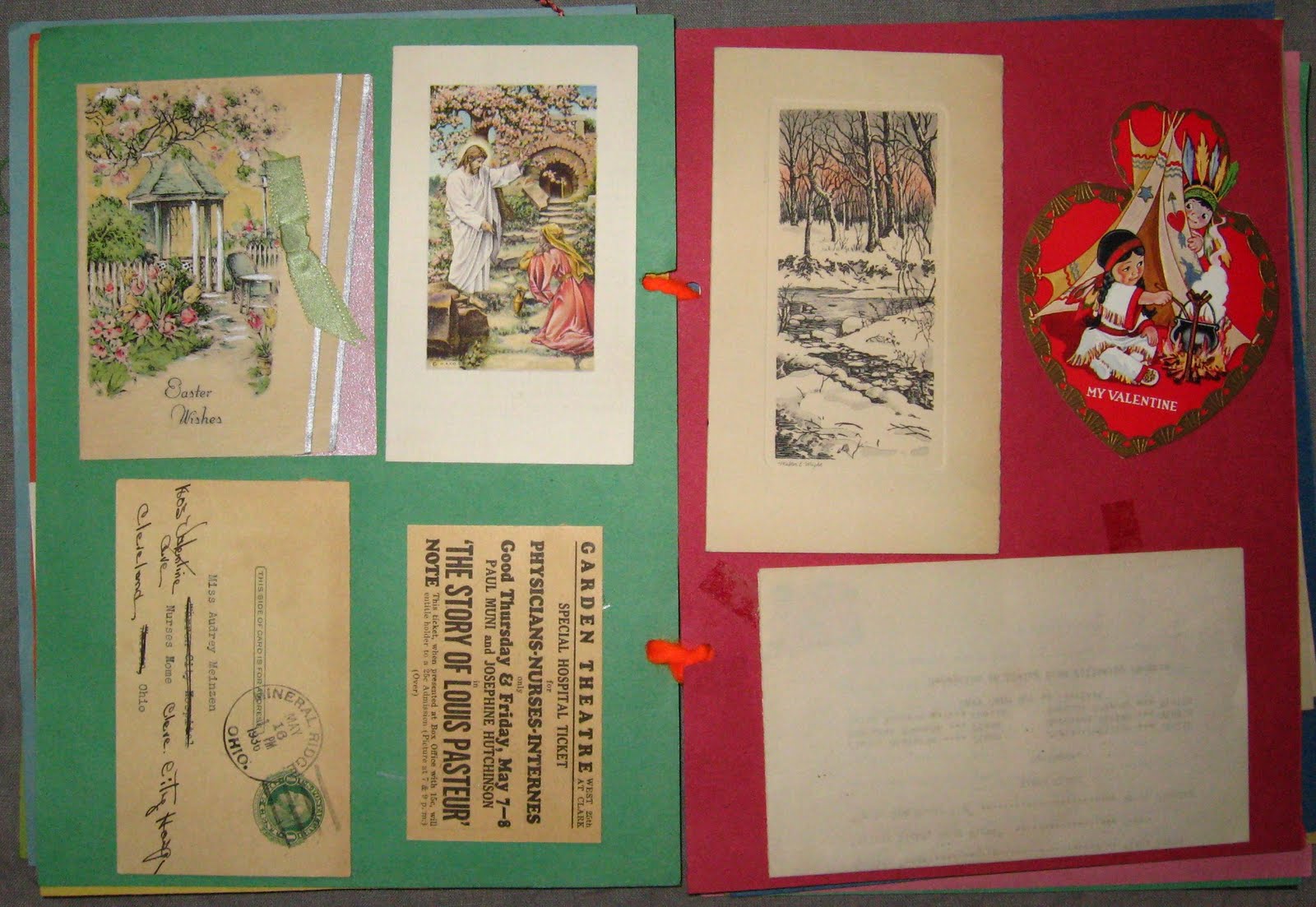
She saved an article about Jane Delano, nurse, from the March 10, 1934, issue of The Girls’ Companion and, years later, when compiling a scrapbook about her years in nurses’ training, she placed it at the top of the first page. Audrey Meinzen’s gaze was directed toward nursing and perhaps she thought of Jane Delano as a role model or heroine. Audrey was the first among her mother and known foremothers to further her education beyond high school in a formal setting.
Audrey, my mother, commented about her childhood in a “grandmother’s book” written for her granddaughter, Holly, that at home she “assumed more responsibility for helping because I was the eldest of four daughters.” After graduating from Mineral Ridge High School in June, 1933, she entered the nurses’ training program at Warren City Hospital. How her parents must have scrimped and saved for her to be able to take such a step, especially during the depression years of the United States. What independence and freedom she must have felt when she moved those 8 miles from the bosom of family to the nurses’ home, where her only responsibilities were herself, her studies, and patient care in the hospital.
With only 12 students, her class was a small one. She became fast friends with a number of the other young ladies. Though she shared no memories of the work and studies of a student nurse, nor memories of her experiences, her classes must have included such subjects as anatomy, physiology, pathology, patient care, charting, etc. During that time period student nurses spent time at other hospitals to learn specific aspects of nursing, such as psychiatry, pediatrics, etc. Audrey saved postcards addressed to her at Cleveland City Hospital, though there’s no record of that hospital’s specialty, nor information about rotations at other hospitals.The student nurses lived in the nurses’ home, a dormitory-like environment. There were strict expectations of behavior including curfews. Weekend curfew was midnight, weeknight curfew was sometimes as early as 8:00 p.m. During the time she was a nursing student, Audrey met her future husband, Lee Doyle. She indicated that he didn’t appreciate the early weeknight curfew. She told him there was studying to be done and early mornings. Missing a curfew meant being grounded for a certain period of time. Mom never indicated that she'd been grounded, but then she never indicated that she hadn't, either.
The Supervisor of Nurses at Warren City Hospital was Gernie Yoder. It seems her responsibilities included training or overseeing the training of the student nurses. She must have written to the out-of-town “girls” on a regular basis to keep them up to date on requirements and activities. Audrey saved one of her letters.One aspect of nursing in the 1930s that I remember my mother talking about was the uniform. Students wore striped dresses with white bib aprons, registered nurses wore crisp white dresses. Students wore black shoes and stockings and all wore a starched-to-cardboard-stiffness cap. Ribbons on the cap were added or changed as the nurse progressed from student to graduate. The group photo of the nursing students, above, shows them in striped dresses with no ribbons on their caps. The photo of Audrey at the top of this post shows her with a striped dress and a narrow ribbon. In her graduation photo, below, she wears a white dress and a wide ribbon. Her cap is long gone, but Audrey saved both black velvet ribbons.
Commencement exercises for the Warren City Hospital School of Nursing were on Friday evening, September 10, 1937. Audrey saved her diploma, printed on heavy parchment, secured by ribbon corners inside a leather folder. She also saved several copies of the graduation program. What pleasure and joy, what a sense of accomplishment she must have felt to have achieved what she set out to do.


The graduates, besides my mother, included Mary Cott Barnes, Gertrude Cunningham, Betty Jane Daugherty, Thelma E. Franks, Ruth Eleanor Haas, Clela Marguerite Huggins, Cora Louise MacDonald, Mary Eleanor McClellan, Leona Marie Paine, Pauline V. Rose, and Verlinda Jean Smith.


The sequence of events after graduation is unclear. Her state registration document was dated April, 1938. In September of that same year, she married Lee Doyle. We know that she worked at Warren City Hospital for a time because she saved a letter received in response to her resignation in November, 1938, signed by Miss Gernie Yoder. By the time of her resignation she was pregnant with her first child.She never returned to formal work as a nurse. I don’t know if she and my father agreed that she would be a homemaker, wife, and mother, or if it was my father’s preference. I believe he always felt that the husband should be the provider in a family and the wife the homemaker and mother. Audrey continued a limited use of her nursing skills on her husband and children, and to some extent, other family members. But sometimes I wonder if, in later years, my mother wished she’d continued the profession of nurse, working outside the home at least part time.
Though she was the first of her mother and known foremothers to obtain further education, she and my father, with only an 8th grade education, ensured that their children’s education didn’t stop with high school. And all of the grandchildren have furthered their education in some way. No doubt, the expectation will continue for future generations. Her desire to learn never ceased: she was a life-long learner with an interest in many and varied topics. I think this is a legacy she passed to her children, who will pass it on to future generations.
After Note
My mom, Audrey, compiled her scrapbook sometime during the 1970s, as evidenced by the thick, bright orange yarn tied through the sides of the pages. Having grown up during the depression, she practiced frugality all her life: she used construction paper for the pages of her scrapbook. I doubt she ever gave a thought to the term archival, and, indeed, perhaps she never thought her scrapbook would be of any interest to her children.
This post will be a participant in the 94th Carnival of Genealogy: The Changing Role of Women. You can learn more about the Carnival of Genealogy at footnoteMaven and also at Creative Gene where across the top of her blog you will see several COG tabs.
Sunday, March 14, 2010
A Kind and Generous Woman
Elvira with her husband, Fred, and 12 of their children.
From left to right:
Della, Alfonzo/Alonzo, Alma or Leota, Alfonzo/Alonzo, Lana, Edward, Fred, Paul, Elvira, John, Mabel, Warren, Beulah, and Brendice.
Strength. Courage. Commitment. Fortitude. Happy. Kind. Generous. These are some of the words I associate with Elvira Bartley Gerner, the woman who is my great-grandmother. Read on to learn a little about her life and times.
On May 17, 1873, five days after Elvira Bartley turned 19, she had her first baby, Ida Adelia. She and Frederick K. Gerner had married 10 months earlier, on July 24, 1872, in Sugar Creek, Butler County, Pennsylvania. Fred was 5 years Elvira’s senior.
In those times, young women married and began their families at a young age. I know very little about Elvira’s early years except that she attended school and learned to read and write. I can guess that she spent time with her mother, learning the mothering, cooking, and household management skills that would be essential when she became a wife and mother in her own home.
Sometime during the 14 months after Ida’s birth, Fred and Elvira moved from Butler County, Pennsylvania, to Putnam County, West Virginia. Pioneers! West Virginia had become a state just 11 years before. What prompted the move of such a great distance? Had Fred been there before? Had they already bought land? Elvira’s older brother, George Washington Bartley, and his wife, Ursula, were next-door neighbors during at least some of the years Fred and Elvira lived in West Virginia. Perhaps they traveled together. Did Elvira find comfort in having a neighbor who was also a family member?
What would that trip have been like? I imagine a horse-drawn wagon packed with the essentials to begin a new life. I imagine, not the level ground of today’s roads, but stony paths over all kinds of terrain. The distance between Butler County and Putnam County these days is about 290 miles. If a horse with a wagon travels about 5 miles per hour, the trip would take nearly 60 hours - just for travel alone. There would have been extra time and stops needed for food preparation, for water, for possible wagon repairs. If they traveled 8 hours per day at 5 miles per hour, the trip would have taken 7 days. Where did they stay along the way? Was there a house, a home, a cottage, a cabin ready for them when they arrived? What was the settling in experience like?
Whatever difficulties they faced, settle in they did. In her home Elvira filled the role of farmer’s wife and mother. She quickly became the mother of more than little Ida. Twins Alonzo and Alfonzo were born 14 months after Ida, in July 1874. Then there was a succession of babies: Lana was born in November 1875; Edward in July 1877; Della in February 1879; Mary Alma in January 1881; and John in November 1882.
Elvira and Fred and their growing family remained in Putnam County until sometime between 1882 and 1884, though they seem to have moved at least once. U.S. census records for 1880 and birth records for seven children indicate living locations of both Scott District and Winfield, the county seat.
Sometime between John’s birth in 1882 and the birth of Bessie Leota in June 1884, Elvira and Fred decided to move back to Pennsylvania. This move, which included eight children between the approximate ages of infant and 10 years, certainly would have been harder than the move south with just one infant. What a trip that must have been! Perhaps it was a wonderful adventure for the children, but it was one which would have required much planning and preparation by their parents.
Elvira’s youngest daughter, Brendice, wrote that her mother’s life must have been hard the first few years and added, “as soon as the children were able to stand, we were told that our feet were to stand on.... Everybody pitched in as soon as they were able and, no doubt, sometimes a little before.”
The move to Pennsylvania took them back to Butler County, specifically to the small town of Bruin. Eight more children were born to Elvira while they lived in Bruin: Bessie Leota in June 1884; Mabel in May 1886; Beulah in September 1888; Warren in July 1890; Ethel in May 1892; Netta (or Meta) in June 1894; Brendice in October 1895; and Paul in April 1898.
Elvira was 44 years old when her last child was born. She’d been pregnant 16 times and nursed 16 babies. About 22 of her 44 years had been lived either pregnant or nursing. How many sleepless nights must she have lived through? How many skinned knees were doctored; heads of tangled hair combed; baths given; clothes sewn, washed and dried by hand; beds made; and meals prepared? All without the modern conveniences of electric stoves, washers, dryers, and sewing machines. A mother doesn’t count, but a mother sometimes gets tired. I am in awe when I think of her stamina and devotion. Brendice commented, “My mother had all us kids, never was seriously ill, [and was] never in the hospital even when she had the babies.... She was a big (not fat), strong woman.” She was physically strong, and she must also been a woman of stamina, fortitude, and strength of character.
Elvira lost two children when they were young: Netta (or Meta) when she was 3 months old, in September 1894; and Ethel, who died of poisoning, in April 1897.
In June, 1900, Elvira and Fred had 11 children, ages 2 to 25 years old, living at home. Ida, Alonzo, and Lana had already married and were gone. Sometime soon after June 1900, Elvira and her family moved to a farm in Fairview Township, Mercer County, where they lived for about 9 or 10 years.
Of those years Brendice wrote, “My parents were just honest, hard-working farmers on a 144 acre farm [with] an eleven room house, and everybody worked.” I don’t know much about the farm and its crops and animals, though I know there was a vegetable garden and there were chickens. Brendice remembered, “Mother thought of the holidays in the fall. She put up some especially nice things to have, like special peaches. Always had a hubbard squash. Since we had chickens she had several nice fat hens instead of turkey and we had all the trimmings. My mother was an excellent cook and loved to put on a big meal.... Since we had all this stuff on the farm I think we lived ‘high on the hog” as the saying goes.” She added, “When I was growing up we never sat down to the table with less than seven or eight people.” Did Elvira ever get out of the kitchen?! How did she manage to prepare meals to feed her large family?! A girl or young woman learns skills in the home of her mother but she comes into her own through practice in her own home. Elvira had lots of practice!
Elvira had her own rubber-tired buggy and her own driving horse which she used to go to the grocery or to visit friends. I imagine Elvira also used her buggy when she served her neighbors. Brendice wrote that her mother “liked everybody to a point. If you needed help, call Mrs. Gerner. She was a midwife to the neighborhood [and] also dressed most of the people who died in the vicinity. They called it ‘laid them out.’ All for free. Her good neighbor policy.” What a great example!
Elvira’s oldest daughter, Ida, died of consumption in 1904, leaving an infant daughter, Lucille. Elvira took over the care of Lucille. Having birthed and cared for 16 children, I wonder if, when she was 50, Elvira felt like she still had the energy to care for an infant. Of course there were 6 daughters still at home to help with little Lucille.
Elvira and her family moved again in about 1908. They returned to Bruin, this time to a smaller farm. By 1910, there were only five children and granddaughter Lucille living with Elvira and her husband. Brendice commented that as the older siblings married and moved away it was lonely without everyone around. Did Elvira feel the same way?
Elvira lost her granddaughter, Lucille, to typhoid fever in 1912; in 1913, her daughter Beulah passed away not long after giving birth to twins; and in 1917, her son Edward died.
By 1920, Elvira and Fred were living alone in a house in Bruin. I wonder if Elvira, 65 at the time, missed having the farm. Surely she wouldn’t have missed all the work, but without the farm work, I wonder what occupied her time. Did she read, embroider, quilt, knit, sew? Did she relax, or was she a woman who stayed active and involved?
Brendice shared other of the attributes of her mother. She said that Elvira was “Scotch Irish (Orange Irish, she would say) and had that Irish wit.... She enjoyed life and people.” She also said that she was “a very happy and kind woman but she ruled the roost.” Wouldn’t the mother of 16 children need to rule the roost?

After Elvira’s husband Fred passed away in March 1926, she remained in Bruin for a time. In April, 1930, she was living on Washington Street, paying $19.00/month rent. During the last years of her life she lived with various children for several months at a time. Two of her living grandchildren remember her staying with their families. Both commented that she was a very pleasant person, that she had a beautiful singing voice, and that she often sat reading the Bible.
I have a photograph of Elvira in old age, sitting in a wheel chair surrounded by adult children and their spouses. She is no longer big and strong, but tiny and almost unrecognizable. During the last several years of her life Elvira suffered from senility. It seems to be the round of life that we begin small, grow large and healthy, become strong adults, and then often begin to lose strength, health, and vitality. I feel particularly sad to know that my great-grandmother, Elvira Bartley Gerner, once so vibrant and independent, lost her mental facilities. I’m grateful that she lived 88 years and that so many of them were lived with health and vigor.
Elvira passed away in Struthers, Ohio, at the home of her daughter, Leota, on February 3, 1943. She is buried in Bear Creek Cemetery near Petrolia, Butler County, Pennsylvania.
I look forward to visiting with Gramma Elvira. I hope to ask her these questions:
– What is your favorite scripture?
– What machine invented during your lifetime affected you the most?
– What were your favorite foods to make?
– Did you sew, knit socks and sweaters, quilt, and/or do other handiwork?
– What was the most challenging experience in your lifetime and what did you learn from it?
Thank you, Gramma, for being such a great example! I love you.
This post was created as a tribute to my great-grandmother, Elvira Bartley Gerner, in conjunction with a timeline, Elvira Bartley Gerner: Her Years from Birth to Burial and was submitted to the 91st Carnival of Genealogy, "A Tribute to Women!"Thanks to Jasia at Creative Gene for organizing the Carnival of Genealogy and to footnoteMaven for the beautiful poster.
--Nancy.
Copyright © 2010 by Nancy Messier.
Elvira Bartley Gerner - Her Years from Birth to Burial
12 May 1854
Born to Dixon and Rebecca (Smith) Bartley in Butler County, Pennsylvania (family Bible)
17 June 1860
Lives at home with parents, Dixon and Rebecca, is 7, attends school (1860 U.S. Census, Pennsylvania, Butler County, Parker Township, M[illegible] Post Office, Dwelling 316, Family #320, Lines 22-31, June 17, 1860)
22 July 1870
Lives at home with parents, Dixon and Rebecca, is 15, attends school (1870 U.S. Census, Pennsylvania, Butler County, Parker Township, Post Office Bruin, Written Page 6B, Lines 13-19, Dwelling #41, House #41, July 22, 1870)
24 Jul 1872
Marries Frederick K. Gerner, Sugar Creek, Butler, Pennsylvania (family Bible; Bible marriage record)
17 May 1873
Ida Adelia born Butler County, PA (family Bible)
between May 1873 and July 1874
Moves to Putnam County, West Virginia. Elvira’s brother and his wife also moved to WV, though possibly before or after Elvira & family moved there. Travel on today’s roads require 287 miles of travel in 4 hours 48 minutes from Butler, PA to Winfield, Putnam Co, WV. (1880 U.S. Census record (citation below) and children’s county birth records)
25 Jul 1874
Twins Alonzo J. and Alfonzo F. born Putnam County, WV (County birth record; family Bible)
16 Nov 1875
Lana Ellen born Putnam County, WV (County birth record; other records give birth years between 1874-76)
16 Jul 1877
Edward G. born Putnam County, WV (County birth record; family Bible)
15 Feb 1879
Della Virginia born in Putnam County, WV (County birth record; family Bible gives birth date of Feb 17)
9 Jun 1880
Lives in Scott District, Putnam County, WV, with husband Fred (farmer), children Ida A (7 years), Alonzo (5 years), Alfonzo (5 years), Lana (3 years), Edward (2 years), and Della (1 year). (1880 U.S. Census, West Virginia, Putnam County, Scott District, S.D. 1, E.D. 112, Printed Page 75, Written Page 19, lines 35-42, Dwelling #13, Family #13, 9 June 1880)
20 Jan 1881
Mary Alma born Scott District, Putnam County, WV (County birth record; family Bible give birth date of Jan. 29)
29 Nov 1882
John N. born Winfield (county seat), Putnam County, WV (County birth record; obituary in “The Youngstown Vindicator,” Wednesday, December 9, 1970, p. 27, column 6. The family Bible gives birth year as 1883; obituary gives year as 1882.)
between Nov 1882 and June 1884
Elvira and her family move back to Butler County, PA (specifically to Bruin, according to her daughter, Brendice) (letters of Brendice Gerner Davis; 1900 U.S. census)
17 Jun 1884
Bessie Leota born Butler County, PA (family Bible)
17 May 1886
Mabel Lodenia born Butler County, PA (family Bible; California Death Index, 1940-1997)
13 Sep 1888
Beulah Mae born Butler County, PA (family Bible)
10 Jul 1890
Warren Franklin born Butler County, PA (family Bible)
15 May 1892
Ethel Clair born Butler County, PA (family Bible; transcribed birth record)
23 Jun 1894
Netta or Meta Mildred born Butler County, PA (family Bible; transcribed birth record)
9 Sep 1894
Netta/Meta Mildred dies Bruin, Butler County, PA (family Bible; transcribed death record)
9 Oct 1895
Brendice Kathryn born Butler County, PA (family Bible; transcribed birth record)
16 Apr 1897
Ethel Clair dies Butler County, PA. Cause of death: poisoned (transcribed death record; family Bible)
30 Apr 1898
Paul Victor born Butler County, PA (family Bible; transcribed birth record)
9 Jun 1900
Lives in Parker Township, Butler County, PA, with husband, Frederick and children, Alfonzo (25 years), Edward (22 years), Della (21 years), Alma (19 years), John (16 years), Bessie (15 years), Mabel (14 years), Beulah (11 years), Warren (9 years), Brendice (4 years), and Paul (2 years) (1900 U.S. Census, Pennsylvania, Butler, Parker Township, S.D. 19, E.D. 86, Printed Page 214A, Written Page 6, 9 June 1900)
9 Oct 1904
Daughter Ida Adelia Heppler dies. Ida’s infant daughter, Lucille, lives with Elvira & Fred. (family Bible; obituary in “The Butler Eagle,” Tuesday, October 11, 1904, p. 4)
~1908
Fred sells the large farm and buys a small farm (Letters of Brendice Gerner Davis, February 27, 1988 to January 2, 1990)
6 May 1910
Lives on Old Meadville Pike, Fairview Township, Mercer County, PA, with husband, Fred, and children Leota (25 years), Beulah (21 years), Warren (19 years), Brendice (14 years), and Paul (12 years) and granddaughter, Lucille (6 years). She is the mother of 15 children. (1910 U.S. Census, Pennsylvania, Mercer County, Fairview Township, Old Meadville Pike, E.D. 145, Sheet No. 114B, lines 77-84, 6 May 1910)
2 Feb 1912
Granddaughter, Lucille Heppler, dies of typhoid fever (obituary; cemetery inventory)
2 Apr 1913
Daughter Beulah Mae Doyle dies, Stoneboro, Mercer, PA. (family Bible; Pennsylvania death certificate)
1916
Lives in Fairview Township, Butler County (near Petrolia) (1916 Butler County Farm Directory)
13 Nov 1917
Son Edward Gerner dies in Mercer County, PA (family Bible)
19 Jan 1920
Lives in Bruin, Butler County, PA with husband, Fred K. (1920 U.S. Census, Pennsylvania, Butler, Bruin Borough, S.D. 19, E.D. 4, Sheet 3B, line 68-69, Dwelling 61, Family 61, 19 January 1920)
26 Mar 1926
Husband, Frederick K. Gerner, dies, Butler County, PA (family Bible; newspaper notice, “Bruin Man’s Will Filed For Probate,” in “The Butler Eagle,” Friday, April 2, 1926, page 17, column 1)
4 April 1930
Lives alone on Washington Street, Bruin, Butler, PA; rents house/apartment for $19.00/month (1930 U.S. Census, Pennsylvania, Butler, Bruin Borough, Washington Street, S.D. 7th, E.D. 10-4, Sheet No. 2A, Printed Page 243, Line 27, Dwelling 37, Family 40, 4 April 1930)
21 Oct 1940
Son Alonzo dies (family Bible; obituary in “Butler Eagle,” Tuesday, October 22, 1940, p. 11)
3 Feb 1943
Dies at the home of her daughter, Leota (Mrs. Fred) Holland, 561 Fourth Street, Struthers, Mahoning County, Ohio (family Bible; Ohio death certificate; obituary in “The Youngstown Vindicator,” Thursday, February 4, 1942, p. 11, col. 5; and obituary in “The Butler Eagle,” Friday, February 5, 1943, p. 2)
6 Feb 1943
Buried, Bear Creek Cemetery, Petrolia, Butler, PA (cemetery inventory, obituaries named above)
This timeline was created in conjunction with the post A Kind and Generous Woman which will be submitted to the 91st Carnival of Genealogy: "A Tribute to Women!"
--Nancy.
Copyright © 2010 by Nancy Messier.
Born to Dixon and Rebecca (Smith) Bartley in Butler County, Pennsylvania (family Bible)
17 June 1860
Lives at home with parents, Dixon and Rebecca, is 7, attends school (1860 U.S. Census, Pennsylvania, Butler County, Parker Township, M[illegible] Post Office, Dwelling 316, Family #320, Lines 22-31, June 17, 1860)
22 July 1870
Lives at home with parents, Dixon and Rebecca, is 15, attends school (1870 U.S. Census, Pennsylvania, Butler County, Parker Township, Post Office Bruin, Written Page 6B, Lines 13-19, Dwelling #41, House #41, July 22, 1870)
24 Jul 1872
Marries Frederick K. Gerner, Sugar Creek, Butler, Pennsylvania (family Bible; Bible marriage record)
17 May 1873
Ida Adelia born Butler County, PA (family Bible)
between May 1873 and July 1874
Moves to Putnam County, West Virginia. Elvira’s brother and his wife also moved to WV, though possibly before or after Elvira & family moved there. Travel on today’s roads require 287 miles of travel in 4 hours 48 minutes from Butler, PA to Winfield, Putnam Co, WV. (1880 U.S. Census record (citation below) and children’s county birth records)
25 Jul 1874
Twins Alonzo J. and Alfonzo F. born Putnam County, WV (County birth record; family Bible)
16 Nov 1875
Lana Ellen born Putnam County, WV (County birth record; other records give birth years between 1874-76)
16 Jul 1877
Edward G. born Putnam County, WV (County birth record; family Bible)
15 Feb 1879
Della Virginia born in Putnam County, WV (County birth record; family Bible gives birth date of Feb 17)
9 Jun 1880
Lives in Scott District, Putnam County, WV, with husband Fred (farmer), children Ida A (7 years), Alonzo (5 years), Alfonzo (5 years), Lana (3 years), Edward (2 years), and Della (1 year). (1880 U.S. Census, West Virginia, Putnam County, Scott District, S.D. 1, E.D. 112, Printed Page 75, Written Page 19, lines 35-42, Dwelling #13, Family #13, 9 June 1880)
20 Jan 1881
Mary Alma born Scott District, Putnam County, WV (County birth record; family Bible give birth date of Jan. 29)
29 Nov 1882
John N. born Winfield (county seat), Putnam County, WV (County birth record; obituary in “The Youngstown Vindicator,” Wednesday, December 9, 1970, p. 27, column 6. The family Bible gives birth year as 1883; obituary gives year as 1882.)
between Nov 1882 and June 1884
Elvira and her family move back to Butler County, PA (specifically to Bruin, according to her daughter, Brendice) (letters of Brendice Gerner Davis; 1900 U.S. census)
17 Jun 1884
Bessie Leota born Butler County, PA (family Bible)
17 May 1886
Mabel Lodenia born Butler County, PA (family Bible; California Death Index, 1940-1997)
13 Sep 1888
Beulah Mae born Butler County, PA (family Bible)
10 Jul 1890
Warren Franklin born Butler County, PA (family Bible)
15 May 1892
Ethel Clair born Butler County, PA (family Bible; transcribed birth record)
23 Jun 1894
Netta or Meta Mildred born Butler County, PA (family Bible; transcribed birth record)
9 Sep 1894
Netta/Meta Mildred dies Bruin, Butler County, PA (family Bible; transcribed death record)
9 Oct 1895
Brendice Kathryn born Butler County, PA (family Bible; transcribed birth record)
16 Apr 1897
Ethel Clair dies Butler County, PA. Cause of death: poisoned (transcribed death record; family Bible)
30 Apr 1898
Paul Victor born Butler County, PA (family Bible; transcribed birth record)
9 Jun 1900
Lives in Parker Township, Butler County, PA, with husband, Frederick and children, Alfonzo (25 years), Edward (22 years), Della (21 years), Alma (19 years), John (16 years), Bessie (15 years), Mabel (14 years), Beulah (11 years), Warren (9 years), Brendice (4 years), and Paul (2 years) (1900 U.S. Census, Pennsylvania, Butler, Parker Township, S.D. 19, E.D. 86, Printed Page 214A, Written Page 6, 9 June 1900)
9 Oct 1904
Daughter Ida Adelia Heppler dies. Ida’s infant daughter, Lucille, lives with Elvira & Fred. (family Bible; obituary in “The Butler Eagle,” Tuesday, October 11, 1904, p. 4)
~1908
Fred sells the large farm and buys a small farm (Letters of Brendice Gerner Davis, February 27, 1988 to January 2, 1990)
6 May 1910
Lives on Old Meadville Pike, Fairview Township, Mercer County, PA, with husband, Fred, and children Leota (25 years), Beulah (21 years), Warren (19 years), Brendice (14 years), and Paul (12 years) and granddaughter, Lucille (6 years). She is the mother of 15 children. (1910 U.S. Census, Pennsylvania, Mercer County, Fairview Township, Old Meadville Pike, E.D. 145, Sheet No. 114B, lines 77-84, 6 May 1910)
2 Feb 1912
Granddaughter, Lucille Heppler, dies of typhoid fever (obituary; cemetery inventory)
2 Apr 1913
Daughter Beulah Mae Doyle dies, Stoneboro, Mercer, PA. (family Bible; Pennsylvania death certificate)
1916
Lives in Fairview Township, Butler County (near Petrolia) (1916 Butler County Farm Directory)
13 Nov 1917
Son Edward Gerner dies in Mercer County, PA (family Bible)
19 Jan 1920
Lives in Bruin, Butler County, PA with husband, Fred K. (1920 U.S. Census, Pennsylvania, Butler, Bruin Borough, S.D. 19, E.D. 4, Sheet 3B, line 68-69, Dwelling 61, Family 61, 19 January 1920)
26 Mar 1926
Husband, Frederick K. Gerner, dies, Butler County, PA (family Bible; newspaper notice, “Bruin Man’s Will Filed For Probate,” in “The Butler Eagle,” Friday, April 2, 1926, page 17, column 1)
4 April 1930
Lives alone on Washington Street, Bruin, Butler, PA; rents house/apartment for $19.00/month (1930 U.S. Census, Pennsylvania, Butler, Bruin Borough, Washington Street, S.D. 7th, E.D. 10-4, Sheet No. 2A, Printed Page 243, Line 27, Dwelling 37, Family 40, 4 April 1930)
21 Oct 1940
Son Alonzo dies (family Bible; obituary in “Butler Eagle,” Tuesday, October 22, 1940, p. 11)
3 Feb 1943
Dies at the home of her daughter, Leota (Mrs. Fred) Holland, 561 Fourth Street, Struthers, Mahoning County, Ohio (family Bible; Ohio death certificate; obituary in “The Youngstown Vindicator,” Thursday, February 4, 1942, p. 11, col. 5; and obituary in “The Butler Eagle,” Friday, February 5, 1943, p. 2)
6 Feb 1943
Buried, Bear Creek Cemetery, Petrolia, Butler, PA (cemetery inventory, obituaries named above)
This timeline was created in conjunction with the post A Kind and Generous Woman which will be submitted to the 91st Carnival of Genealogy: "A Tribute to Women!"--Nancy.
Copyright © 2010 by Nancy Messier.
Subscribe to:
Posts (Atom)

