Showing posts with label videos. Show all posts

Thursday, May 8, 2025

The Unsolved Mysteries of Grampa's Sweet Potato


In the living room of my grandmother's house was a built-in, glass-front bookcase.  And in that bookcase was what my grandmother called a sweet potato.  We cousins laughed.  "A sweet potato?!"  She told us it was a musical instrument but she did not show us how to play it.  She said it was Grandpa's and that it had been his father's before him.  Grampa was W. C. Robert Meinzen and his father was Henry C. Meinzen.

The sweet potato (also known as an ocarina), above, right, is not my grandfather's but looks similar.  Thanks to musiking for permission to use the above image from Pixabay.

When I saw this article about ocarinas at Atlas Obscura I remembered Grampa's sweet potato.  It seems that the modern ocarina, like my grandfather's, was invented by Giuseppe Donati in 1853 in Budrio, Italy.  The shape of the instrument evolved over time until he perfected the design.  Then he created five different ones, each with a different pitch.  In 1863, Donati and several other musicians formed an ocarina quintet which eventually became a septet.  By 1870, the group was playing in European cities.

There are several mysteries surrounding my grandfathers' sweet potato.

Mystery Number 1
After Gramma died in 1973 I didn't hear anyone mention the sweet potato, and I didn't think about it.  After Grampa died in 1979, we thought about it because it was his.  The sweet potato was gone, nowhere to be found.

What happened to that sweet potato?  I doubt we'll ever know because my grandparents are dead and so are all their daughters who, at the time of their parents' deaths, seemed unable to shed light on its whereabouts or what happened to it.  Did Gramma or Grampa give it away, maybe to one of the grandchildren or a cousin?  Or donate it, thinking it was of little value?  Did one of the sisters secretly take?  It will continue an unsolved mystery.

Mystery Number 2
My great-grandfather, Henry, was born in Germany (either Prussia, Hanover, or Germany depending on which record you read) in 1837.   He immigrated to the U.S. in 1866.  Where did he get the sweet potato?  Did Henry see and hear the ocarina septet somewhere in Germany (carrying ocarinas to sell), where he heard them, and bought one?  Did the ocarina group travel to the U.S. and Henry bought one from them?  Did someone give it to him as a gift?  Did he buy it from a mail order catalog after he came to the U.S.?  There are so many possibilities I can't number them.  Whatever happened, it will remain an unsolved mystery. 
W. R. Robert Meinzen with violin and Benjamin Harrison with guitar
Mystery Number 3
Could either of my grandfathers actually play the sweet potato?  Were either of them musically inclined?  There is no evidence either way.  In fact, the only evidence of musicality in that line of our family is a photo of my grandfather and his brother-in-law, Benjamin Harris, in which Grampa is holding a violin and Uncle Ben is holding a guitar.  Both look as if they're playing the instruments.  But were they?  Yet one more unsolved mystery surrounding my grandfathers' sweet potato..

I always put the sweet potato in the category of the children's musical instrument,the recorder (or tonette as ours was called in fifth grade).  I was surprised and delighted to learn how beautiful ocarinas can sound and that there are musical groups and festivals devoted solely to the instrument.  There are many videos of groups on YouTube but I liked Gruppo Ocarinistico Budriese best.  I hope you enjoy the music.


Other videos of Gruppo Ocarinistico Budriese are The Typewriter, Napolincanto, a group of four songs, and Cinema Paradiso

—Nancy.

Copyright © 2025 Nancy Messier.  All Rights Reserved. 
Do not copy or use any content from this blog without written permission from the owner. 

.

Friday, January 21, 2022

Elizabeth Laws, Place Names, and Accents/Dialects

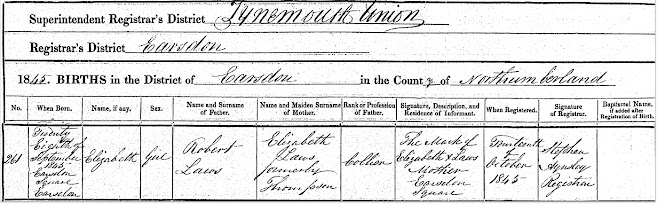
Elizabeth Laws is a paternal great-great-grandmother.  Family records/lore/legend tell me she was born in Youssen Square, England, on October 28, 1845.  In the 15 years I've been searching for ancestors I've never been able to find a place called Youssen Square.  And here, now, from her U.K. birth certificate, I see that she was born in Earsdon Square, Earsdon, Northumberland, with no mention of Youssen.  Hmmmm. 


This is a transcription of her birth certificate from UK GRO Year 1845, Quarter Dec, District Tynemouth Union, Vol 25, Page 399.
Superintendent Registrar's District   Tynemouth Union
Registrar's District   Earsdon
1845. BIRTHS in the District of  Earsdon in the County of Northumberland
No.  261
When Born.  Twenty Eighth of September 1845 Earsdon Square Earsdon
Name, if any.  Elizabeth
Sex.  Girl
Name and Surname of Father.   Robert Laws
Name and Maiden Surname of Mother.   Elizabeth Laws formerly Thompson
Rank or Profession of Father.  Collier
Signature, Description, and Residence of Informant.   The Mark of Elizabeth X Laws Mother  Earsdon Square
When Registered.  Fourteenth of October, 1845
Signature of Registrar.  Stephen Aynsley Registrar

Clearly, if this official record is to be believed, Elizabeth Laws's date of birth was 28 September, 1845, and her place of birth was Earsdon Square, Earsdon, Northumberland.

I'm really curious to know how "Earsdon" in Northumberland, England, became "Youssen" in Pennsylvania.  What accent in British English translated one to the other in American English?  I wondered what I don't know about pronunciation of English place names, specifically in the county of Northumberland.  So I started searching. 

Probably the best video I found with pronunciations of towns in Northumberland was the one at ChronicleLive.  Since I was unable to publish the video here, you'll need to click the link to watch and listen to this 2-minute video.  Sadly, Earsdon is not mentioned and I've come away with no understanding as to why or how Earsdon became Youssen among my Doyle ancestors. 

Despite not understanding how the names changed, I'm thrilled to have a birth certificate that states the date and location of my grandmother Elizabeth Laws's birth.

-–Nancy.

Copyright © 2022 Nancy Messier.  All Rights Reserved. 
Do not copy or use any content from this blog without written permission from the owner. 

.

Thursday, January 20, 2022

A 1929 Video Interview with an 87-Year-Old Man


Be sure to turn your speakers up and, if possible, put the captions on.  They're not completely accurate but still helpful.  The first half of the video is a restored and colorized version of the original film; at about 4:55 see side-by-side versions of the original and the restored film.

I love his sentiment that work is something you have to do but if you're doing something you like and want to do, that's play. 

I also appreciated knowing that a 50 mile trip in the speaker's younger years took all day, whereas in 1929 or so, it took him and his son an hour and a half. 

I first saw this at Eastman's Online Genealogy Blog.

How I wish I had a recorded interview of one of my own ancestors!

--Nancy.

Saturday, May 8, 2021

Hannah Glasse of Northumberland and Her Recipe for Plague Potion

I hope you enjoy this presentation by Hannah Glasse from the Northumberland Archives.


Hannah was the author of the 1747 cookbook, The Art of Cookery Made Plain and Easy Which far exceeds any Thing of the Kind ever yet Published, which was republished into the 1800s and again in the 21st century.  I particularly enjoyed this video of Hannah with her delightful accent as she shared a few cookery tricks from the mid- to late-1700s.  And who of us wouldn't benefit from her plague potion during these Covid times?  Based on my knowledge of the herbs included, it will have a strong (and perhaps unappealing) fragrance.
 
Since visiting Colonial Williamsburg many years ago I have been a fan of character reenactors from times past.  When well-researched and heartily presented, I believe they can cast a light into the past, giving us a window through which we can view life as it might have been for our ancestors who lived many decades ago. 

I sometimes berate myself for taking time to watch videos such as these and to research non-ancestors.  And then I remind myself that, in this case, some of my foremothers from Northumberland and other counties in England, and possibly America, may have used Hannah's cookbook, if they could read.  (And I do hope they could read.)  Those foremothers from England include Martha (Reay) Doyle, Elizabeth (Thompson) Laws, Mary (Bell) Reay, Eliza (Hartley) Armitage, Hannah (MNU) Armitage, Martha (MNU) Hartley, and unknown others.

If you'd like to read a little more about Hannah Glasse, I recommend

As far as Hannah's cookbook, you can view a facsimile of the original here at Archive.org.  The first pages are blank so scroll down to image 10 to begin.  Your local library probably also has a version available for loan.  And if you'd like to own your own copy there are many available for purchase at booksellers across the internet. The original versions will cost between $300.00 to over $1,000.00, the reproductions significantly less.  As for me, I reserved a Dover version from my local library and am eager to see it. 

-–Nancy.

Copyright © 2021-2026 Nancy Messier.  All Rights Reserved. 
Do not copy or use any content from this blog without written permission from the owner. 

.
Monday, February 19, 2018

If My Ancestor Spoke, Would I Understand?

The title of Melody Lasalle's post, "Harry Jackson, I Need to Talk to You," caught my eye this past week.  Perhaps because I've been researching a line of ancestors from England, I immediately wondered whether I would be able to understand my ancestors if I could ask them questions.  Would their accents (and mine for them) make communication difficult? 

I delight to hear accents -- from any part of the U.S., from England, or from anywhere else in the world -- and I especially enjoy hearing British accents.  But enjoying an accent doesn't mean I always understand what the speaker is saying.  Sometime an interpreter would be helpful. 

Thinking about my Northumberland ancestors and their probable accents sent me to the internet to see what an accent from that county might sound like.  I found several youtube videos and read viewers' comments who pointed out that there's a difference between the accent of a native speaker and the accent of a non-native speaker imitating the native speaker.  Based on comments, I think the three videos below were the best examples of the native language of Northumberland (excluding the even more localized accents of Pitmatic and Geordie).

This particular video, below, has 30 dialects from around the U. K. but it will begin mid-video where someone from Northumberland speaks for a minute or two.  (You can listen to all the accents by restarting the video.)


This next video comes from the British Drama Club.  It is a recording on vinyl and is a little scratchy but, in my opinion, worth listening to for the accent.


And this last video comes from the Northumbrian Language Society.  Listen closely.  Even then you may not understand all the words.


I know that language changes over time so it would be hard to definitively say that my ancestors from Northumberland sounded like any of these speakers.  No matter how much or little the language changed over nearly two centuries, I suspect that their accents would be a challenge for me to understand today.  But I'd certainly be willing to try!  I would hope my ancestors would be patient with me, too.  (For anyone interested in learning more about the language of Northumberland, see Northumbriana, website of the Northumbrian Language Society.)

So, tell me, did you catch everything the speakers said?  Or were there parts that sounded like a foreign language?

Have you ever considered whether it could a challenge to have a conversation with any of your ancestors because of accents or language?

--Nancy.

Copyright ©2018, Nancy Messier. All Rights Reserved.
.

Wednesday, February 7, 2018

Byker-Hill, Northumberland

The place names in England -- names like Byker-Hill, Walls End/Wallsend, Ponteland, Spittal -- are interesting and curious to me.  They were the locations where my ancestors were born, baptized, married, lived, or died.  I can't help wanting to know more about them. 

In the 1800s, Byker-Hill (or Byker Hill or Byker) was located east of Newcastle upon Tyne in Northumberland.  Historically, according to the website Byker Lives, there were several coal pits there as well as quarries, brick, lead, and glass works, flax mills, and a tannery.  Byker is now a geographic area within the city of Newcastle in Northumberland.

Among my Northumberland ancestors, Byker Hill is the location of several events.
  • Elizabeth Thompson was born in Byker Hill in 1817, according to the 1871 and 1881 U.K. Census.  Elizabeth married Robert Laws in 1834.
  • William and Martha (Reay) Doyle lived in Byker-Hill when their son, William, was baptized in 1828.

These two couples are in-laws.  In 1863, Elizabeth Laws, daughter of Robert and Elizabeth (Thompson) Laws married Andrew Doyle, son of William and Martha (Reay) Doyle.

While researching Byker-Hill, a town where my coal mining ancestors lived, I came upon a song by that title.  It should have been no surprise that it was about coal miners.  The nearest I could come to learning its origin was that it was a folk song, written in the early 1800s.  It's probable that my Doyle and Laws ancestors heard and perhaps even sang "Byker Hill."  I share this in honor of the men in those families who were all "collier lads."  (Sing along if you like:  the lyrics are below the video.)


            Byker Hill

            If I had another penny
            I would have another gill
            I would make the piper play
            The Bonny Lass of Byker Hill

            Chorus
            Byker Hill and Walker Shore
            Collier lads for ever more
            Byker Hill and Walker Shore
            Collier lads for ever more

            When first I come down to the dirt
            I had no trousers and no pit shirt
            Now I've gottin' two or three
            Oh Walker Pit's done well by me.

            Chorus

            The pitman and the keelman trim
            They drink bumble made from gin
            Then to dance they all begin
            To the tune of Elsie Marley

            Chorus

            Geordie Charlton had a pig
            He hit it with a shovel and it danced a jig
            All the way to Walker Shore
            To the tune of Elsie Marley

            Chorus

            Oh, gentle Jenny's behind the barn
            With a pint of ale underneath her arm
            A pint of ale underneath her arm
            And she feeds it to the baby

            Chorus

As is true of many folk songs I found three or four variations of lyrics and more than a few extra or alternate verses.  You can see several variations here at Mainly Norfolk:  English Folk and Other Good Music.

How I wish there were photographs of Byker-Hill from the 1800s.  I would like to know what it looked like.

--Nancy.

Copyright ©2018, Nancy Messier. All Rights Reserved.
.

Sunday, April 16, 2017

High and Holy Hymning:  He Is Risen!


                    He is risen! He is risen!
                    Tell it out with joyful voice.
                    He has burst his three days' prison;
                    Let the whole wide earth rejoice.
                    Death is conquered; man is free.
                    Christ has won the victory.

                    Come with high and holy hymning;
                    Chant our Lord's triumphant lay.
                    Not one darksome cloud is dimming
                    Yonder glorious morning ray,
                    Breaking o'er the purple east,
                    Symbol of our Easter feast.

                    He is risen! He is risen!
                    He hath opened heaven's gate.
                    We are free from sin's dark prison,
                    Risen to a holier state.
                    And a brighter Easter beam
                    On our longing eyes shall stream.

I wish you the blessings of a joyful Easter!

--Nancy.
.

Thursday, December 22, 2016

The Sussex Carol - Blog Caroling with footnoteMaven

Again this December footnoteMaven has invited us to Blog Carol by posting our favorite Christmas carol.  Thank you, fM!

My favorite changes each year but is always the carol with the tune that dances in my mind or with lyrics that twirl in my brain.

This year I've chosen "The Sussex Carol," also known (at least to me) as "On Christmas Night All Christians Sing."  It may have been composed as early as the late 1600s and several variations of the lyrics exist.  The ones with this post were collected by Ralph Vaughan Williams, probably in the early 1900s.  Below is the 2008 Choir of King's College singing the carol.  The lyrics follow.  I hope you sing along and enjoy.


                                       The Sussex Carol

                         On Christmas night all Christians sing
                         To hear the news the angels bring.
                         News of great joy, news of great mirth,
                         News of our merciful King's birth.

                         Then why should men on earth be so sad,
                         Since our Redeemer made us glad,
                         When from our sin he set us free,
                         All for to gain our liberty?

                         When sin departs before His grace,
                         Then life and health come in its place.
                         Angels and men with joy may sing
                         All for to see the new-born King.

                         All out of darkness we have light,
                         Which made the angels sing this night:
                         "Glory to God and peace to men,
                         Now and for evermore, Amen!"


Come carol with other family history bloggers.  Click through to footnoteMaven's post, fM's Tradition of Blog Caroling, where you can find links to others' favorites in the comments.

I wish you and yours a Merry Christmas!

--Nancy.

Copyright ©2016 Nancy Messier. All Rights Reserved.  .

Wednesday, November 30, 2016

Preparing for Christmas, Lighting the World

This post is a slight detour from my usual family history posts.  Please bear with me (or ignore if not interested).  I'll get back to regular posts tomorrow.

December is a busy month for those who celebrate Christmas  It's also a time when most people are more generous, kind, and thoughtful than usual.  This year our church is offering the theme "Light the World" and suggesting 25 ways over 25 days that we can follow in the footsteps of our Savior, Jesus Christ, and thoughtfully incorporate His example into our daily activities from now until Christmas Day.  I'm thinking of this as a service Advent calendar.  I hope you'll watch this beautiful inspirational video for a brief introduction.


Each day has a theme based on some action or teaching of the Savior accompanied by suggestions/ideas for service activities which follow His teachings.  There is a clickable "calendar" here.  When you click the date you'll see brief video and specific suggestions for the theme of the day.  You can also download an advent calendar of "In 25 ways. Over 25 Days" here.

These are the themes.  Click the date to see a brief video and ideas for giving service on that date.
December  1 -  Lift others’ burdens.
December  2 -  Honor your parents.
December  3 -  Help the blind.
December  4 -  Worship.
December  5 -  Serve the sick.
December  6 -  Read scripture.
December  7 -  Feed the hungry.
December  8 -  Pray for others.
December  9 -  Visit the lonely.
December 10 -  Help the disabled.
December 11 -  Serve children.
December 12 -  Teach others.
December 13 -  Show humility.
December 14  - Clothe the needy.
December 15 -  Worship through music.
December 16 -  Show compassion.
December 17 -  Care for your mother.
December 18 -  Honor the Sabbath.
December 19 -  “Calm the storm.”
December 20 -  See potential in others.
December 21 -  Forgive others.
December 22 -  Show gratitude.
December 23 -  Be a peacemaker.
December 24 -  Care for your loved ones.
December 25 -  Follow the Savior, Jesus Christ.

Isn't this a wonderful way to emulate the Savior and keep Him in mind during this Christmas season?!  I hope you'll join me. 

--Nancy.

#LIGHTtheWORLD

Sunday, May 22, 2016

When Dixie Paper Meets Family History

I thought this commercial was too fun.  (You never know when family history
will be the topic of conversation.)


--Nancy.
.

Sunday, May 15, 2016

Family Tree

I recently discovered the song "Family Tree," written by John Forster and Tom Chapin, and thought you might enjoy hearing it.  If the box below doesn't work, click this link.


Should you like to sing along, here are the lyrics.
Family Tree

Before the days of jello
Lived a prehistoric fellow
Who loved a maid and courted her beneath a bamboo tree.
And they had lots of children
And their children all had children
And they kept on having children until one of them had me.

Chorus
We're a family and we're a tree.
Our roots go deep down in history.
From my great great granddaddy reaching up to me,
We're a green and growing family tree.

My grandpa came from Russia,
My grandma came from Prussia.
They met in Nova Scotia,
Had my dad in Tennessee.
Then they moved to Yokohama,
Where Daddy met my Mama.
Her dad's from Alabama
And her mom's part Cherokee.

Chorus

Now one fine day I may go
To Tierra del Fuego.
Perhaps I'll meet my wife there
And we'll move to Timbuktoo.
And our kid will be bilingual
And though she may stay single,
She could of course co-mingle
With the King of Kathmandu.

Chorus

The folks in Madagascar
Aren't the same as in Alaska.
They got different foods, different moods
And different colored skin.
You may have a different name
But underneath we're much the same.
You're probably my cousin
And the whole world is our kin.

Chorus

You can tell that this fellow has done his research, though sadly he provides no documentation.

You can listen to John Forster sing more songs here.  

--Nancy.
.

Sunday, March 27, 2016

Hallelujah, He Is Risen!

I couldn't choose between two videos and decided to share both.  The first is about my Savior Jesus Christ and the second is the Hallelujah Chorus.  Enjoy!


Happy Easter to you and yours!

--Nancy.
.

Saturday, February 13, 2016

Direct Links to RootsTech 2016 Videos

The following videos of presentations are available at RootsTech 2016 Video Archive as of Friday, February 12, 2016.  Please note that if you click through to any of the links, the video may appear below the fold at the RootsTech website so be sure to scroll down.

Thursday
Friday

Saturday

I'll try to come back and add the length and and also the session numbers so it will be easy to find a syllabus for each.  I'll also try to notice whether more videos are added over the next week or two and add them to this list.

--Nancy.
.

Wednesday, December 23, 2015

A Carol for 2015 - Caroling with footnoteMaven

As November turns to December, I begin listening to quiet Christmas music in the background of my other activities.  At least one song or carol always stays pleasantly in my mind and becomes my favorite for the year.  It is so this year.  "What Sweeter Music" by John Rutter is not a traditional carol but I love it just the same.


Here are the lyrics in case you'd like to sing along or can't understand as you listen.

               What Sweeter Music
               by John Rutter

               What sweeter music can we bring
               Than a carol, for to sing
               The birth of this our heavenly King?
               Awake the voice! Awake the string!

               Dark and dull night, fly hence away,
               And give the honor to this day,
               That sees December turned to May.
               That sees December turned to May.

               Why does the chilling winter's morn
               Smile, like a field beset with corn?
               Or smell like a meadow newly-shorn,
               Thus, on the sudden? Come and see
               The cause, why things thus fragrant be:
               'Tis He is born, whose quickening birth
               Gives life and luster, public mirth,
               To heaven, and the under-earth.

               We see him come, and know him ours,
               Who, with his sunshine and his showers,
               Turns all the patient ground to flowers.
               Turns all the patient ground to flowers.
               The darling of the world is come,
               And fit it is, we find a room
               To welcome him. To welcome him.
               The nobler part of all the house here, is the heart.

               Which we will give him; and bequeath
               This holly, and this ivy wreath,
               To do him honour, who's our King,
               And Lord of all this revelling.

               What sweeter music can we bring,
               Than a carol for to sing
               The birth of this our heavenly King?
               The birth of this our heavenly King?


I hope you're having a joyful Christmas season.  I wish you and those you love God's richest blessings!

I'm sharing this post on Friends of footnoteMaven's Facebook Group.

--Nancy.
.

Sunday, August 2, 2015

The Family Tree


I liked this song and thought you might, too.

--Nancy.
.

Saturday, April 4, 2015

Monday, March 30, 2015

A Midwife's Tale:  The Diary, the Book, the Film, the Websites

I learned of midwife Martha Ballard a number of  years ago when a friend recommended I read Laural Thatcher Ulrich's book, A Midwife's Tale:  The Life of Martha Ballard Based on Her Diary, 1785-1812.  Since I have a midwife great-grandmother I thought it would be interesting reading even though their lives were nearly a century apart.  As it turned out, my great-grandmother and Martha seemed to have little in common other than helping mothers give birth to babies but, nonetheless, I found the book compelling reading.  Ulrich includes entries from the diary then interprets and discusses them, adding information and informing our understanding of the environment and times in which Martha lived.

Last year I learned that American Experience on PBS Home Video had available "A Midwife's Tale," which is based on Martha's Diary and Ulrich's book.  I promptly reserved it at our local library and watched it.  I thought it was exquisite.  I felt like I'd jumped back to rural Maine in the late 1700s.  It is narrated by Ulrich with music by Orison and shape-note singing by Word of Mouth Chorus.  As with her diary, the focus was not exclusively devoted to the duties of a midwife but included Martha's own family, her garden, her animals, keeping her house, making fabric and clothes, the weather, etc.

Further research led me to a website devoted to Martha Ballard's Diary:  DoHistory, "a site that shows you how to piece together the past from the fragments that have survived.  Our case study:  Martha Ballard."  At this website you can learn more about Martha, see digital images of her diary, and read about the creation of the film.  On Process of Making a Historical Film, you can learn about the research that went into making the movie and the efforts for historical accuracy.  I really like the thought that "the past is a foreign place" because it helped me realize how seriously the producer/writer, Laurie Kahn-Leavitt, took the making of this film and how important it was to strive for accuracy. 

Additionally, you can visit PBS's website, American Experience : A Midwife's Tale where you can find links to even more information about the film including links to special features,

I can't say enough good about the book and the film.  They go hand-in-hand, one with the written word, the other bringing the written word to life.  If you have female ancestors who lived during the mid- to late-1700s into the early 1800s, you won't want to miss reading this book and watching the film to find a deeper understanding of the lives of the women among your ancestors.

--Nancy.

Copyright ©2015-2019, Nancy Messier.  All Rights Reserved. 
Do not copy or use any content from this blog without written permission from the owner. 

.
Sunday, January 4, 2015

A Kindred Spirit!


Helen F. M. Leary on the history of genealogy, the comforts people find in researching their ancestors, and her thoughts on researching, serendipity, and the individuals who were our ancestors.  She is delightful and I'm so thrilled to learn that at least one other person thinks about ancestors the way I do.

Thanks to Wendy Lavender who posted this on the Facebook Genealogy Do-Over page.

--Nancy.
.

Wednesday, December 31, 2014

Coorie Doon - Workday Wednesday


 And a second, more lullaby-like version:


I have coal mining ancestors on both sides of my family.
I was thinking of them today. 

In this lullaby, "coorie" means to "cuddle" or "crouch" and "doon"
means "down."  Matt McGinn, the composer and lyricist, likens the
image of a child falling into the darkness of sleep to the father
going down to the darkness of the mine.

     A Miner's Lullaby (Coorie Doon)
     by Matt McGinn

         Coorie doon, Coorie doon, Coorie Doon, my darling,
         Coorie doon the day.
         Coorie doon, Coorie doon, Coorie Doon, my darling,
         Coorie doon the day.

     Lie doon, my dear, and in your ear,
     To help you close your eye,
     I'll sing a song, a slumber song,
     A miner's lullaby.

     Your daddy's doon the mine, my darling,
     Doon in the Curbly Main,
     Your daddy's howkin' coal, my darling,
     For his ain wee wean.

     There's darkness doon the mine my darling,
     Darkness, dust and damp,
     But we must have oor heat, oor light,
     Oor fire and our lamp.

     Your daddy coories doon, my darling,
     Doon in a three foot seam,
     So you can coorie doon my darling,
     Coorie doon and dream.

--Nancy.
.

Wednesday, December 24, 2014

Related Posts Plugin for WordPress, Blogger...