Showing posts with label census-1940. Show all posts

Thursday, August 2, 2012

A Laurel Wreath for Helping Index the 1940 U.S. Census

FamilySearch Indexing Indexer Badge
Family Search keeps giving us nice little rewards for indexing the 1940 U.S. Census. Did you get yours? If not, you can copy it from me or find it here
We -- everyone who indexed -- should be pleased with ourselves to have done it in 4 months! I was reading comments on a post at the FamilySearch blog today and some indexers complained about how the arbitrators changed their entries and mentioned other challenges and difficulties they had indexing. I think it was a learning process for everyone involved and I know we'll all just keep getting better and better as we continue to index.

It will take another several weeks for all the states' indexes to be posted because they are checking them. The FamilySearch blog explains the delay.

Well done! Thank you, everyone who indexed.
.

Sunday, May 6, 2012

From the National Archives - The 1940 Census - Census of the Population

I can think of two ways to see what 1940 was like: watch old movies produced in that year; or watch this 10 minute National Archives instructional film for census takers. No doubt it was helpful to the census takers but it's interesting to me for the views of 1940 activities. Times have changed!

Saturday, May 5, 2012

Observations While Indexing the 1940 U.S. Census

I've transcribed only about a dozen pages in the census, mostly in Ohio. I've noticed two interesting differences between then and now:
  • Many families had lodgers, sometimes one, sometimes several. Not so these days.
  • Extended family members often lived together. Relationships to head of household that I noticed included parents, brothers, sisters, nieces, nephews, grandchildren, fathers-in law, mothers-in-law, and one uncle.
Many families had many people living in the same home. It caused me to wonder how large the homes were.


What interesting things have you noticed while indexing the 1940 U.S. Census?

Sunday, April 22, 2012

How to Index the 1940 Census

I know many of us bloggers are already indexing the 1940 census (and I hope anyone who reads this blog who isn't indexing will give it a try). I just found this short, helpful video. I knew enough to do the job fairly well but after watching this I know enough to do a better job and do it more easily. Enjoy!

Saturday, April 21, 2012

A Lot Can Happen in Ten Years

I was thinking today about how much a person's life can change during the ten years between census reports. It's especially true for teenagers who become adults during those the ten years.

For example, my father, Lee Doyle began the decade as a farm boy of 17, living in Stoneboro, Pennsylvania, with his father, stepmother, and step-siblings.  His paternal grandparents lived nearby.

In 1933 his father died leaving him in a home where he was no longer welcome.  Several months after his father's death he moved to Niles, Ohio, where his maternal aunt, Brendice Gerner Davis, and her husband, Raymond, helped him find a job in a steel mill.

In 1936, his paternal grandmother, Tressa Rose Froman Doyle, died.  She was probably the closest person to a mother he'd known:  she raised him after his own mother passed away when he was a baby.


Audrey Meinzen, my mom, lived at home with her parents and three younger sisters in Mineral Ridge, Ohio, in 1930.  She was 15.

In 1933 she graduated from high school and began nurse's training.

She graduated in 1937, took her boards and became a registered nurse.  She began working at Warren City Hospital. 

My parents met while she was in nurse's training and he was newly employed at a steel mill.  They were introduced by one of my mother's classmates and began dating.


They married in the autumn of 1938 and had a baby in May, 1939.

By the time the 1940 census was taken, they had an 11-month-old son.


Sometimes ten years is a long time; sometimes it's not very long at all.

Tuesday, April 17, 2012

It Was Ironing Day, the Day the Census Taker Came

The census taker came to the home of my parents, Lee and Audrey Doyle, on Tuesday, April 16th, 1940. On Monday he'd been to her grandparents' home one street away and to the homes of neighbors on the opposite side of Furnace Street. Today, Tuesday, he worked his way up the north side of Furnace Street, finally arriving at their home in the half-double they rented from the Frymans.

Yesterday Mom had done the wash. I wasn't there but I know it's a fact as sure as I know what color my eyes are. For as many years as I knew her - nearly 50 - Mom did the wash every Monday. Small load, large load, many loads, few loads. Always. Monday was the day she did the wash no matter what.

She'd been married not yet two years in April, 1940, and was the mother of an 11-month-old baby boy. Scrubbing diapers by hand on a scrub board in a laundry tub, wringing them out by hand, and hanging them to dry was not easy work but it was part of the routine of her life now. (Not that her rough, sometimes-raw hands appreciated the task.) There was no hanging the clothes outside to dry on Monday: it was only about 50 degrees and partly cloudy. Not a good drying day. She'd no doubt noticed the newspaper ads for electric washing machines but on Dad's salary of $1540.00/year, there just weren't funds to buy a washer, at least not yet. She would carry on doing it by hand (what choice did she have?) and some day - some day - she would have a washing machine.

As sure as Monday was wash day, Tuesday was ironing day. She'd already made breakfast for her little family and herself, played with the baby and then put him down for his nap. Now she was getting ready to iron. She'd sprinkled the clothes yesterday afternoon so they’d be damp all the way through. She set up the ironing board, plugged in the iron, and waited for it to heat. It was like magic to watch the iron glide over wrinkles, leaving behind fabric as smooth (if not as shiny) as glass. Handkerchiefs, boxer shorts, skirts, dresses, pants, and shirts. Every piece, smooth and wrinkle-free. It wasn't easy, especially the shirts with all their details, but at least it wasn't a hot day. And baby was taking his nap. It was a peaceful time to iron and think.

Mom was an inveterate reader of newspapers throughout her life and, after the advent of TV, almost religiously watched the evening news. She was interested in the events of the world outside the environment of her little family, home, and Mineral Ridge. As she ironed that Tuesday in 1940, she no doubt thought about world events. For weeks news of the war raging in Europe had been splashed across The Youngstown Vindicator’s front pages. The headlines were upsetting.

BRITISH SINK 7 NAZI DESTROYERS, EXTEND MINEFIELDS IN KATTEGAT
Attack on Scandinavia Probably Just a Prelude to Real German Blitzkrieg
BRITISH ARMY LANDS IN NORWAY, FDR SAYS AMERICA MUST PREPARE
ALLIES SEND 100,000 TO NORWAY, BRITISH TAKE MARVIK, BOMB NAZIS


And the war news wasn’t on just the front pages these days. More than a few pages of every issue were filled with articles about the war in Europe. You couldn't escape news of the war. Some recent headlines deep in the center pages of the newspapers read:
  • Nazis Claim British Ship Is Sent Down
  • Says Belgium Stays Neutral
  • Germans Fire Upon Swedes
  • Chamberlain Says Nazis 'Shut Gates of Mercy'
  • Says Allies Force Hitler To Fight War Their Way. Lippman Finds German Conquests Have Removed Buffers Between Reich and Foes” by Walter Lippman
  • French Plane Shot Down In Battle over Belgium
  • German Troops Push Ahead In Southeastern Oslo Region. Norwegians Fleeing into Sweden. Report Food Situation Is Extremely Serious
What was this world coming to? War was a terrible thing but she hoped it would stay in Europe and not touch America’s shores. She hoped America wouldn’t have to be involved at all. What she really hoped was an end to war in the world.

And then Mr. George L. Bell came to the door to take the census. Good. It would take her mind off worrisome news. On her way to answer the door she realized the baby was awake and needed her attention. Thank goodness Lee was home: he could answer the census taker's questions.

Dad was employed as a fire man (one who stoked the fires) at a steel mill, The Niles Rolling Mill. No doubt he worked turns and would be headed out for a 4-to-midnight shift a little later in the afternoon. While Mom was concerned about family, home, and world events, Dad’s concerns were probably directed toward providing a good living for his little family, keeping them safe, and doing a good job at work. He’d come from the farm in Pennsylvania almost 7 years ago with nearly nothing to his name. Now he had a wife and son, was renting a decent home, and was providing for the needs of his family. Work was hard and they weren’t on top of the world yet, but life wasn’t bad. They’d do okay if they were careful and watched their pennies.

Dad was very private about financial matters. So private that Mom never knew how much he earned during the years he worked. That day in 1940 he answered the census taker's questions but was the answer about his income positively, accurately truthful? If so, we know that he earned $1540.00 annually, an amount equal to about $23,677.00 in 2010. There’s no doubt they were on a tight budget at $128.33 per month. Rent was $18.00/month. There were income taxes, food and clothing; gasoline and auto repairs; water, coal, and electricity to pay for. Not to mention that they were trying to save for a down payment on a house. It helped that Dad was a handyman. By doing repairs and upkeep on the car himself they could keep expenses down.

They ate dinner not long after the census taker left. Mom was careful about the food she purchased and prepared, making sure that each meal offered a balanced diet. She was a thrifty shopper and found the best deals. Dad preferred meat and potatoes for dinner every day, prepared one way or another. Mom did her best with the food budget she had but it wasn’t always easy. With only one car she couldn’t always get to the stores with the least expensive prices. Of course she canned and preserved food during the summer months. It was a skill she’d learned from her mother. Tonight's dinner was roast pork with boiled potatoes, fresh carrots and celery, applesauce, and beets. Maybe tomorrow they could get by with pork and beans.

Dad left for work and Mom spent some time playing with her little son. After a light evening meal and more play, she put him to bed. With the radio on in the background, she stitched repairs on some clothes and let her mind wander back over the day. She hadn’t accomplished a lot but it was enough. The ironing was finished, some mending was done, and she'd dusted and swept and cleaned the house. She'd made meals for her little family and spent time with her husband and son. She’d get a good night’s sleep -- if she could just not think about the war in Europe. What would the world be like and where would she and her family be in 1950 when the census taker came around again?
. . . . . . . . . .

This post is a contribution to Carnival of Genealogy, 1940! The Carnival is hosted by Jasia at Creative Gene and will be published some time during the first week of May. Thanks for hosting, Jasia!

.

Monday, April 16, 2012

FamilySearch Indexing: 1940 Census Project Updates Website


It you're indexing the 1940 U.S. Census with FamilySearch, this Project Updates page might be helpful to you. Find guidance and information about how to index or how to improve your indexing plus other useful information about the 1940 census.

Saturday, April 14, 2012

Walking through the 1940 Mineral Ridge Census with Mr. George L. Bell

Mineral Ridge, Ohio, was a small village of 22 streets in 1940. It straddled the border between Trumbull and Mahoning Counties. The less-than-mile long main street, unsurprisingly called Main Street, was a gentle, low-grade hill sloping from north to south.   Side streets, most only one block long, extended east and west from Main Street.

Meandering through Mineral Ridge's 46 pages of the 1940 U.S. Census was like taking a little tour of the Ridge.   Street by street, page by page, I could track the methodical walk of George L. Bell, the census taker.   Going from house to house, one by one, he visited each of its 461 homes.  He commenced his duties in Mineral Ridge on Tuesday, April 2, and reached the last house on Wednesday, May 1.

He began his route on Ohltown Road on the south end of the Ridge.  He'd written "Old Town Road." He was right that it was an old town: an old coal mining town with the mines long since closed.   He reached Main Street, traveled north, then went down one side of each side street and back up the other, returning again to Main Street.   There were few side streets on the west side of Main.  When he reached the last one toward the center of the village, he crossed over to the east side of Main Street and began his walk down one side of each side street and up the other.

As I followed Mr. Bell's circular route through the pages of the census, the street names were like old friends.  I could imagine them all in my mind's eye. Depot Street was named for the railroad tracks which it crossed.  My mother always said a train whistle was a lonely, haunting sound, the sound of a loved one being carried away from home.  And there was Blunt Street.  On the east side of Main Street, there were "Kelley" (correctly spelled Kelly), Harding, and Williamson Streets.   There was Morris Street, where my great-grandparents, Edward Jesse and Mary Bickerstaff, had lived in the house that Grampa built.

Furnace Street, where my parents and grandparents lived, ran parallel to Morris Street.  They say Furnace Street was named for the furnaces that stood at its end in the heyday of the Ridge's coal mining days.  Down past our house on Furnace Street was a beautiful woods.  As a child my parents told me I could not go into that woods.  It came across to me almost as a penalty of death if I trespassed.  The woods, with its tall trees, offered cooling shade and inviting places to investigate.  But I resisted the temptation, reasoning that if I crashed through into one of the mines, I would die; if I escaped that death, I would die at the hands of my parents for disobeying (believing my parents would have stealthily found out that I'd been in the woods - my mother was like that!).

Other streets were Locust Street; Burnett Street, where my cousin lived; Prospect, Carver, and Warner Streets.   Warner Street was in the country when I was young.  It was all farmland then and a wonderful place to ride a bike.  On to Salt Springs Road, then back to Ohltown Road again and on to Main Street.

Main Street, State Route 46, was a main thoroughfare and was the only paved road in Mineral Ridge.  The side streets of the Ridge were covered with tar-bound Macadam:  a layer of tar coated with small gravel which was pressed into the tar.   There were no sidewalks.   In the photo above you can see how rural the road looks -- 20 years after the 1940 census was taken.  Mr. Bell must have had a dusty time of it.

With Mr. Bell I visited the Seiferts, Garlands, Keelings, Crofts, Ludwicks, Breezes, Morrises, and the Aults.   None of the children I knew were in those homes.   None of us were born yet.  But families stayed in the Ridge for several generations.  I went to school with grandchildren of some of some of those families.  Grandchildren of other residents of the Ridge were already grown.  There was Dr. Caskey and his wife, who sometimes substituted when I was in elementary school.  She recommended that I read The Secret Garden.  There were the Hiblers, the Michels (with a daughter who was my aunt's best friend), the Bakers, and the Frymans, all on Furnace Street.   (Three of their homes are pictured in the photo above.)   There were names I didn't recognize, too, of people who died or moved on before I was born.

I don't know how Mr. Bell felt about taking the 1940 census in Mineral Ridge but it was very satisfying following along behind him.  I'm grateful for the impression I had to look through the pages of the census before it was indexed.  By doing so I was able to learn who the neighbors of my family were and reminisce about little Mineral Ridge.  I probably won't be around when the 1960 census comes out.   Perhaps my grandchildren will find my classmates in many of the homes on its pages.

--Nancy.

Copyright © 2012-2016 Nancy Messier. All Rights Reserved.
. 

Friday, April 13, 2012

I Succumbed

I wasn't interested in searching the 1940 U.S. Census. I had no interest because I already knew plenty about family members who were living in 1940. I knew when and where they were born, who their parents were, their occupations, their spouses and marriage dates, when they died. I didn't think the census could give me much more information.

Then I learned what questions were being asked in the census and my curiosity was piqued. Still, I decided I would wait till the census was indexed before searching for them. That post I wrote about finding Enumeration Districts (E.D.) and maps? I looked up the Ridge to write the post but I didn't write down the E.D. I really wasn't going to search until it was indexed.

But something happened. Mineral Ridge is such a small village -- a long Main Street with just a few short side streets. It wouldn't take long to have a quick look. Then I realized it was the last census in which I would find four of my great-grandparents. Next, I became curious about where my father worked and how much he earned; and about my grandfather who lived a few doors away. One thing led to another. . . . And I succumbed.

There's something about seeing an ancestor's name on a document, especially a document with so much information in it. I guess you could say curiosity got the best of me. That can't be a bad thing when it's family history we're talking about, right?


.
.
.

Thursday, April 12, 2012

Help for FamilySearch Indexers

Whether you're indexing the 1940 Census or any other documents, be sure to look at FamilySearch's Indexing Resource Guide. I just discovered it today and have found it interesting and useful. Maybe you will, too. It's divided into several sections.

Some of it's offerings in the help section include
Indexers can find
  • an indexing tutorial
  • a list of indexing projects many screens long. When you're a registered indexer you can choose which one you'd like to work on (though, of course, everyone hopes you'll choose to work on the 1940 census until it's finished!).
  • the User's Guide. This may be the best kept secret for any indexer. It was updated in March, 2012, and comes as a 124-page pdf download. Chapter topics are Indexing; Participating in FamilySearch Indexing; Basic Indexing Guidelines; Adjustment to the Indexing Screen; Get Help; Get Training; and Arbitration. My personal opinion is that this guide will be best-used when you have a question. Some may prefer to read the guide before doing beginning to index but for me, I think it would confuse and deter me if I hadn't already started the indexing process.
  • and much morehttp://www.blogger.com/img/blank.gif
And don't miss the handwriting and language resources on FamilySearch's Indexing Resource Guide. There are resources for reading England handwriting as well as resources for six other languages.

Randy Seaver at Genea-Musings and The Ancestry Insider often post helpful indexing tips, too.


Indexers for FamilySearch have made great progress. I hope the enthusiasm continues. Wouldn't it be fun to finish sooner than predicted?!
.

Monday, April 2, 2012

My Back-Up Plan for the 1940 Census

Other commitments today prevented me from searching the 1940 U.S. Census. Even if I had, by the looks of other bloggers' experiences, I would have had trouble getting to the census images. I suspected that servers would be overloaded and crash and/or that "my" states wouldn't be immediately available. I'm as excited as everyone else to see what I find about my family in 1940.

Since I can't do anything about not being able to see the census images I'm putting my back-up plan into effect: I'm indexing.

How about you? Have any of you readers of my blog already indexed pages from the 1940 U.S. Census? If so, please leave a comment and tell me about your experience. Thanks.
.

Sunday, March 25, 2012

From the National Archives, about the 1940 Census

I hope you enjoy this brief presentation of the the behind-the-scenes work of the employees of the National Archives. Learn about their preparations to make the 1940 U.S. Census available on April 2, 2012.


.

Tuesday, March 20, 2012

Practicing for April 2

I spent some time this afternoon practicing my indexing skills, warming up my fingers and eyes in preparation to better index the 1940 U.S. Census on April 2. Just 13 days!

I'm probably more prepared to index than I am to find my ancestors in the 1940 Census. I haven't yet identified the Enumeration District (E. D.) for every family and/or individual I hope to find. But there's still a little time to look at the maps.

Have you looked at the 1940 U.S. Census Community Project blog yet? (Just click on the highlighted text and a new window will open with the blog in it.) There's a brief, interesting post there comparing the media blitz about the census in 1940 and the media blitz this year. Go to the blog to read about the excitement in 1940. The excitement this year? This will be the first time ever that a U.S. Census will be released to the internet and not on microfilm. Thank you, technology!

Have you signed up to index yet? Indexing is the process of looking at a digitized version of an original record and typing some specific information from it into boxes in the indexing program. Names, dates, ages, and locations are some of the most important pieces of information to index for a census. Once the census is indexed, it will be available for free public use. We'll be able to type in a name and, with a little luck, our ancestor's name will appear as a clickable link. Another thanks and tip of my hat to technology.

You can download the indexing software at the 1940 U.S. Census Community Project or at the FamilySearch Indexing page where, I just found, you can try a sample index project. (Click any of the highlighted words to go to the sites which will open in new windows.)

Won't you please join me in warming up your fingers?
.

Sunday, March 11, 2012

Any Day But Friday

My mother, a member of "the Greatest Generation," always discouraged me from starting anything (reading a book; writing a letter; a sewing, cleaning, or painting project; etc.) on a Friday unless I could finish it on Friday. I don't know if that idea was based on her own lack of success in finishing things on Fridays or not. From my own experience, the projects I've started on Fridays have been challenging to complete if they take longer than that day. Maybe interest dwindles over the weekend.

On Friday night I downloaded the census indexing program from the 1940 U.S. Census Community Project website. I hesitated, remembering my mom's admonition. Then I realized that since downloading the program was all I did, it was both started and completed on Friday. Whew! Safe. No worries about it not getting done the same day.

Not wanting to take any chances with my lack of finishing things on Fridays, I waited to begin indexing until today. Of course I doubt that the need for indexing will ever end in my lifetime so it probably would have been okay to start on Friday: I can index till I die (or my vision goes).

Reading the instructions and agreement and downloading the program didn't take long at all and now I have this cute little icon sitting on my desktop. I click it and up pops an indexing screen which greets me with "Welcome, Nancy" and shows new messages for indexers; instructions; options for choosing what to index; and tools to help me understand the process. I wanted to share the process with you but when I signed the agreement to index, I agreed not to make and post screenshots of what I was working on. Instead, I found a video that shows the process. If you're hesitant to start indexing because you don't know what it might be like, this video will show you.


Indexing is a satisfying use of my time. In the end, my work will help others as well as myself. In addition to that, it feels like it stretches my brain just a little because I'm learning something new. Since there are different levels of indexing and a great variety of projects, that learning will continue into the future.

Want to give indexing a try? Don't wait till Friday. Begin today.

.

Friday, March 2, 2012

1940 U.S. Census Community Project


The 1940 U. S. Census Community Project is sponsored in part by Archives.com, FamilySearch, and findmypast.com. Society sponsors are the National Genealogical Society (NGS), Federation of Genealogical Societies (FGS), and the Association of Professional Genealogists (APG).

Together they are hosting the indexing initiative for the 1940 U.S. Census. When the census becomes publicly available online on April 2, it will be pages of completely unindexed census records. Many of us who have been seeking our ancestors online for the past 8 or 10 years have become very comfortable with, maybe casual about, how easy it is to find our ancestors in records offered at Archives.com, FamilySearch, findmypast.com, and other online sites, especially if we haven't indexed before. Perhaps we even take the indexed census records for granted.
Will we be surprised when we finally see the pages of the 1940 census? Will we know where to look to find our ancestors? Will we wish its pages were indexed already?

Indexing can't begin until April 2, but you can prepare now by downloading and installing the software at 1940 U.S. Census Community Project. After you do that you can try your hand at indexing a "batch" of records. Start now!

I've always loved the saying, "Many hands make light work."


Census image above from Measuring America: The Decennial Census From 1790 to 2000, p. 62.
.

Monday, February 27, 2012

If You Know Where They Lived in 1940...

... it will be easier for you to find your family and ancestors in the 1940 U.S. Census. It may not be easy but it will be easier.

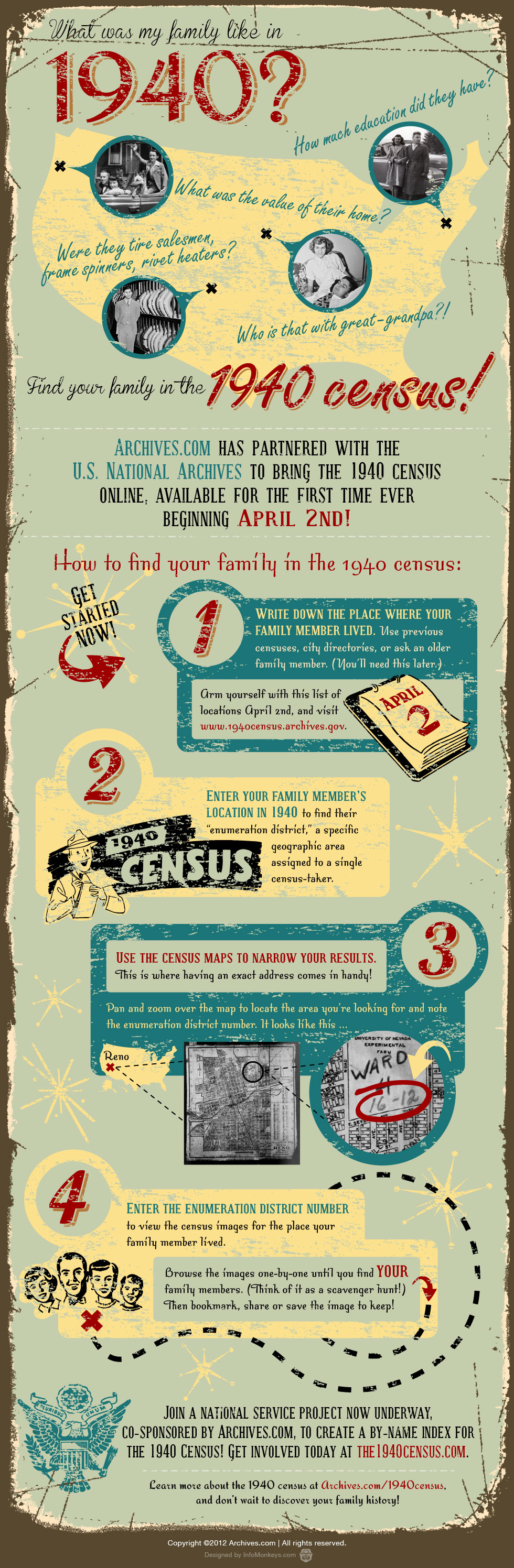
If you know the state, county, town/city, and street name, the maps at 1940 U.S. Federal Census (http://www.1940census.net/1940_enumeration_district_maps.php) will help you find the enumeration district (E.D.). With the E.D. at hand, you will be able to browse the census images which will be available on April 2, 2012.

--->Don't confuse 1940 U.S. Federal Census with the 1940 U.S. Census Community Project. The two are completely different websites.<---

My parents lived most of their married lives in Mineral Ridge, Trumbull County, Ohio. I just recently learned that the little village of Mineral Ridge crossed the boundaries of two counties: Trumbull and Mahoning. I'm also in the situation of having parents who married in 1939. I know they lived in Niles and in Warren after they married but I don't know when they bought their home in Mineral Ridge. If they're not in the Ridge in 1940, I'll be looking for them in the two other cities.

Below, on the left is Trumbull County, on the right is Mahoning County. You can see the outline of the Ridge in both. Although in two different counties, the E. D. is the same for the whole village.


Not all census maps are created equal. The one for Mineral Ridge has only the main thoroughfares named. It's unimportant since the village of Mineral Ridge is all in the same E.D. On the maps of large towns and cities which have many enumeration districts the street names appear. If your ancestor lived on a named street in a large town or city you'll probably be able to find it on a map and identify the E.D.

Please note that after you click "Get ED Map Images" the next screen that opens may give you a list of two or more maps to view. You may need to look at more than one to find the street you're searching for.

. . . . . . . . . . . . . . . . . . . . . . . . . . . . . . . . . . . . . . . . .

When the 1940 Census becomes available on April 2, it will not be indexed. If we have no idea where our ancestors lived, we'll have little hope of finding them until the census is indexed. I encourage you to help index at the 1940 U.S. Census Community Project. You'll help yourself and help others, too.


.

Saturday, February 25, 2012

1940 U.S. Census Ambassador

Are you getting excited about the release of the 1940 U.S. Census? I am. It wasn't until I learned what the questions in the census were that I began to realize the wealth of information I will find (if the census taker took care of his assignment) about several generations of my family: that of my parents, that of my great-grandparents, and my great-great-grandmother. Exciting!

Did you know that there's a 1940s U.S. Census Blog? You can read some fun and interesting posts about the census and about the 1940s. That generation had survived and was just coming out of the Great Depression but had not yet become involved in World War II. From afar they watched changes in European countries, including Hitler's take-over of numerous countries from the mid-1930s on. What must they have wondered and thought?

I'll be posting more about The 1940 Census in the coming days and weeks. As of Saturday, February 25, there are just 37 more days until the Census is released.
Related Posts Plugin for WordPress, Blogger...