Showing posts with label Northumberland England. Show all posts

Saturday, June 11, 2022

Living Conditions of Coal Miners in Northumberland, England, ~1860

I find it fascinating to read contemporary descriptions of the living situations of my forebears.  Perhaps the description below isn't exactly accurate for them but certainly some aspects mirrored their lives.  My earliest known coal mining ancestors in Northumberland predate the publication of the book below by several decades but my great-great-grandfather Andrew Doyle was a coal miner before 1860 and until his emigration to the U.S. in 1869.  Andrew's father-in-law, Robert Laws, was also a coal miner and alive in 1860.  I can only hope that conditions in 1860 had improved compared to earlier decades when these men's fathers and grandfathers were miners.   

This excerpt comes from A Memoir of Northumberland, Descriptive of Its Scenery, Monuments, and History, a book written by William Sidney Gibson, M.A., published in 1860.  It is available in its entirety here at Google Books.  The description below is on pages 32-33.
. . . Although the pitmen are an unpolished race, and as regards religious and secular instruction have too generally been left as uncultivated as their dialect is uncouth, they share the Northumbrian energy of character, and, where they have acquired any education at all, there are constant examples of their desire for knowledge, especially in applied sciences.  Great allowances must be made for this Troglodytean class of labourers, for they spend their youth and vigour cramped in close and impure air in a high temperature, are liable to instant destruction from the 'fire-damp' and equally fatal 'choke-damp' of the mine, and lead a cheerless life which almost separates them from the world of breeze and sunshine.  Where libraries have been formed for the colliers . . . upon the Tyne, the men readily avail themselves of such advantages, and it appears that works of imagination are especially in demand.  Allotment gardens, too, are becoming very generally cultivated in the collier villages.  The wages of the pitmen are good, and sufficient for their wants, and there are a few colliery villages where a school is not maintained besides a reading-room or mechanics' institute. . . .  In the coal-mining districts, unfortunately, a boy is no sooner able to earn some wages than he is taken from school; and, as regards benefit societies, the helpless widows and children of coal-miners have still to lament the want of a provident or assurance fund, a provision which the coal-owners ought to assist their labourers in making, for although of late years, from greater care and improved ventilation, there have been fewer of the frightful explosions that used to bring sorrow and destitution to scores of families at once, there is an increase in the number of deaths in coal-pits in proportion to the number of tons of coal now raised.  So much for the physical condition of the labouring population.

Observations and Comments
  • Can I absolutely trust Gibson's descriptions or were they written from some elevated status and by comparison to his own situation?  The adjectives and descriptions seem somewhat demeaning.  (I have to remind myself that it was England where there were already classes at different levels of society, and it was 1860.)
  • Regarding their "uncouth" dialect, I don't know if the author is referring to accent, manner of speech, choice of words, or something else, or maybe something more.  Language is always evolving.  Research suggests that the early Northumbrian dialect was not in use in 1860 but there were probably remnants of it.  The online magazine, Living North, has an interesting article about the language.  And you can listen to a man from Northumberland describing the farmhouse where he grew up here at the British Library.  I can't think of the language as "uncouth" but I admit I have to pay very close attention to understand what he's saying.  Of course, more than a century separates Gibson's book and this audio recording.
  • Perhaps religious and secular instruction were minimal but I have been pleased to see that my ancestors were married in churches and their children christened in them.
  • I like the description "energy of character" and to read that they had a desire for knowledge.
  • Troglodytean refers to cave-dwellers.  While the miners did not dwell in caves the comparison seems somewhat appropriate:  both caves and mines are dark and dank.  (Or was the author suggesting something else?)
  • From census records I see that many of the boys of my ancestral families began working in the mines at 10 or 12 years of age.  The description, "they spend their youth and vigour cramped in close and impure air . . . and lead a cheerless life which almost separates them from the world of breeze and sunshine," seems accurate, from what I've learned in my research of coal mining.
  • Libraries!  Good to know that there were sometimes libraries available.
  • Gardening, good wages, schools -- all good (except the boys ending their formal education so early).
  • Causes of death, widows and orphans....  I have not yet (and hope I don't) discover a Northumberland mining ancestor who died in a mining accident and left a widow and children.  (William Doyle, father of Andrew Doyle, did die from being run over by a cart wheel but I've been unable to determine whether it was in a mine or not.  He left his wife, Martha Reay Doyle, pregnant and with five children ages 12 and younger.)

I don't know if there will ever be enough resources to get an accurate view of ancestors' lives, but each additional source gives me a slightly broader glimpse.

-–Nancy.

Copyright © 2022 Nancy Messier.  All Rights Reserved. 
Do not copy or use any content from this blog without written permission from the owner. 

.

Monday, June 6, 2022

Coal Miners' Cottages, Bedlington Colliery, Northumberland, England

In my day to day life my ancestors are never far from my mind.  I wonder about their days—the work they were doing (especially the women and children), what the weather was like, how they cooked and what they ate, whether they planted a garden . . . .  I especially wonder about their home environment.

Not long ago I discovered Bedlington Northumberland Extensive Urban Survey, prepared by the Northumberland City Council.  Several of my ancestral lines lived in or near Bedlington, Northumberland, including my Doyle, Reay, and Laws families.  This survey contains a rich history of the area.  I was especially interested to read a description of the homes where coal miners and their families lived.

Might my ancestors have lived in a cottage like one of these?
Miners Cottages, Pit Village, Beamish Museum, courtesy Wikimedia Commons

Or these?
Miners Cottages, Pit Village, Beamish Museum, courtesy Wikimedia Commons

The above survey noted that in 1849, terraced cottages, likely constructed of brick, were built at Bedlington Colliery for 300 colliers and their families.  This is how they were described: 
. . . each with a small garden behind . . . living rooms of about 14 feet square with a pantry behind, the floor is flagged and generally has a bed in it.  There is a chamber above—reached by a step ladder.  The room is open to the slates.  A detached stone or brick oven in front, serves for baking bread for the inhabitants of a row of some 20-30 cottages.  Pigsties were generally a distance from the house at the bottom of the garden (Rawlinson 1849, 36).

It's unclear to me whether the first floor has just a single, 14-foot square room, or more than one.  From the looks of the cottages in the photos above, I suspect there's one room at the front of the house and a pantry room behind it.  I try to envision my coal mining ancestors and their families living in a room 14" square.  What a different life compared to mine.  Possessions would have been minimal.  

Another description of the miners' cottages and the living environment of coal miners comes from A Memoir of Northumberland, Descriptive of Its Scenery, Monuments, and History by William Sidney Gibson, M.A., published in 1860.  (See pages 32-32.)

He writes that agricultural labourers' homes were favored above most cottages in the pit-villages of the mining population and then describes the cottages of the miners. 
Long rows and aggregations of unsightly cottages, peopled only by those who earn their living from the adjacent pits, mark too many of the colliery districts; and the cottages, especially where the property is leasehold, are generally hideous, sordid, barrack-like abodes, not indeed destitute of cleanliness and homely comfort, but totally wanting in the humanising though humble adornments of southern rustic homes:  no flowers grace these dwellings of dusky toil, no verdure relieves the bare cindery earth around them. . . .

This information certainly gives a perspective of my ancestors' lives that I hadn't considered before, lives that were Spartan, simple, minimal.  And oh, the coal dust that must have been everywhere!  In the absence of physical comfort, I hope their homes were enhanced by love.

-–Nancy.

Copyright © 2022 Nancy Messier.  All Rights Reserved. 
Do not copy or use any content from this blog without written permission from the owner. 

.

Friday, January 21, 2022

Elizabeth Laws, Place Names, and Accents/Dialects

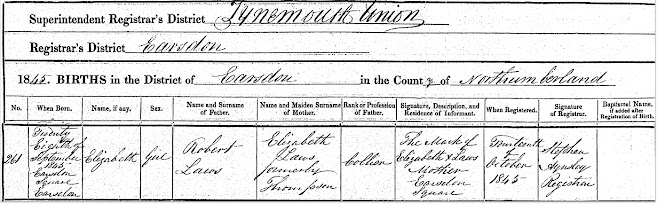
Elizabeth Laws is a paternal great-great-grandmother.  Family records/lore/legend tell me she was born in Youssen Square, England, on October 28, 1845.  In the 15 years I've been searching for ancestors I've never been able to find a place called Youssen Square.  And here, now, from her U.K. birth certificate, I see that she was born in Earsdon Square, Earsdon, Northumberland, with no mention of Youssen.  Hmmmm. 


This is a transcription of her birth certificate from UK GRO Year 1845, Quarter Dec, District Tynemouth Union, Vol 25, Page 399.
Superintendent Registrar's District   Tynemouth Union
Registrar's District   Earsdon
1845. BIRTHS in the District of  Earsdon in the County of Northumberland
No.  261
When Born.  Twenty Eighth of September 1845 Earsdon Square Earsdon
Name, if any.  Elizabeth
Sex.  Girl
Name and Surname of Father.   Robert Laws
Name and Maiden Surname of Mother.   Elizabeth Laws formerly Thompson
Rank or Profession of Father.  Collier
Signature, Description, and Residence of Informant.   The Mark of Elizabeth X Laws Mother  Earsdon Square
When Registered.  Fourteenth of October, 1845
Signature of Registrar.  Stephen Aynsley Registrar

Clearly, if this official record is to be believed, Elizabeth Laws's date of birth was 28 September, 1845, and her place of birth was Earsdon Square, Earsdon, Northumberland.

I'm really curious to know how "Earsdon" in Northumberland, England, became "Youssen" in Pennsylvania.  What accent in British English translated one to the other in American English?  I wondered what I don't know about pronunciation of English place names, specifically in the county of Northumberland.  So I started searching. 

Probably the best video I found with pronunciations of towns in Northumberland was the one at ChronicleLive.  Since I was unable to publish the video here, you'll need to click the link to watch and listen to this 2-minute video.  Sadly, Earsdon is not mentioned and I've come away with no understanding as to why or how Earsdon became Youssen among my Doyle ancestors. 

Despite not understanding how the names changed, I'm thrilled to have a birth certificate that states the date and location of my grandmother Elizabeth Laws's birth.

-–Nancy.

Copyright © 2022 Nancy Messier.  All Rights Reserved. 
Do not copy or use any content from this blog without written permission from the owner. 

.

Wednesday, August 18, 2021

Waggonways in Northumberland, England

Waggonways was a new word I discovered a few months ago, of interest to me because it relates to my coal mining ancestors.  This post is the result of a tangent from usual research to follow a BSO (a bright, shiny object). 
Waggonways in Northumberland
For all the research I've done to find my coal mining ancestors and the environment of the mines where they worked, it never once occurred to me to wonder how coal was transported from the colliery to the next stop on its journey. 

Learning about waggonways has been fascinating.  At first I thought the word referred only to the pathway the coal carts followed to take coal to a river but the phrase is more inclusive and refers to the path or track, the cart, the horse, and the equipment needed to move coal from the colliery to the river.  The first waggonways were paths the horses trod pulling carts full of coal.  Eventually two parallel rails were laid on the pathways and cart wheels were made with rims to fit the rails.  The waggonways were a precursor to our modern railway system.  From what I can tell, waggonways were primarily used in the northeastern counties of England, especially in Northumberland where many of my coal mining ancestors lived.

There seem to have been several benefits to waggonways.
  • The path for the carts was smoother and its direction was controlled by the rails.
  • The path allowed the horses to continue pulling their carts no matter the weather.  No more horses mired in the mud after spring rains.
  • Because the paths were smooth, horses could pull heavier loads which meant more coal could be transported at one time.  A horse could pull 10.5 tons (21,000 pounds!) for 24 miles.  It's hard to  imagine that a wooden cart could hold that much weight, let alone that a horse could pull it!
Waggonway in Summer (from Seaton Delaval to Whitby Bay
Waggonway in Summer
(from Seaton Delaval to Whitby Bay)
cc-by-sa/2.0 - © Christine Westerback
geograph.org.uk/p/706555
Used under Creative Commons License.
 
Some of the old waggonways have been restored (but without the rails) and used as bicycling or walking paths.

A few years ago the Willington Waggonway, an intact waggonway from the late 18th century that was buried, was discovered at a shipyard in Tyneside, Northumberland.  It has been restored and is in the process of preservation.  This article at ChronicleLive gives details and shows great photos of the track as well as images of the carts. 

I look at the photos of the waggonways paths now and think how charming they look.  I have to remind myself of the work--the hard physical labor!--they represent, summer and winter, spring and fall:  the miners who dug the coal, the men and boys who were associated in any way with coal mines, as well as the ponies in the mines below ground and the horses who pulled carts along these paths.  What a lot of work!

If you'd like to learn more about or see photos of Waggonways, click on these links.
  • Wylam Waggonway explores the history of Heddon and the Wylam Colliery Waggonway and includes maps, diagrams, illustrations, and a timeline which extends beyond the colliery's use of the waggonway.  (The font is very tiny and light grey = a bit of a challenge for old eyes.)
  • Waggonways provides a brief description of waggonways and links to other photos. 
  • Plessey Wooden Waggonway includes a brief history of the Plessey Waggonway, a drawing of a horse and cart, and diagrams of a cart (called a chaldron) that was still in use in 1965.  The brief history gives details I haven't read elsewhere.
  • Amusing Planet's post, The Wooden Wagonways of Britain, gives lots of interesting detail about waggonways and some excellent photos of wagons and the restoration work of the Willington Waggonway.
  • Northumberland Wagonways gives information about the transition from waggonways to railways. 
  • The History Blog has a good article about waggonways and the restoration of the Willington Waggonway.

 Below are recent views of two other waggonways.  My 3x-great-grandfather, William Doyle, a coal miner, died in Plessey after having been run over by a cart wheel.  I have no further details and don't know whether or not his death was work-related.  Perhaps the cart wheel was on a coal cart below-ground or perhaps a wagon like one in the photos at the top of this post.

Plessey Old Waggonway
cc-by-sa/2.0 - © Tim Fish
geograph.org.uk/p/261166
Used under Creative Commons License

Wylam Waggonway at Street Houses
cc-by-sa/2.0 - © Andrew Curtis
geograph.org.uk/p/5100870
Used under Creative Commons License.
-–Nancy.

Copyright © 2021 Nancy Messier.  All Rights Reserved. 
Do not copy or use any content from this blog without written permission from the owner. 

.

Wednesday, January 20, 2021

The Places They Lived: Robert and Elizabeth (Thompson) Laws & Their Family, from 1810 to 1881

As I was editing my source titles in RootsMagic I noticed, again, how often Robert and Elizabeth (Thompson) Laws, my great-great-great-grandparents, moved.  If the 1851 and 1861 U.K. Censuses can be trusted for accuracy of the birth locations of the children, it looks like it was every few years.  (There are a few variations in other census records.)

The years and the places they lived
  • 1810   Jarrow, Durham - Robert born
  • 1817   Bykerhill, Northumberland - Elizabeth born
  • 1834   Tynemouth, Northumberland - Robert & Elizabeth married
  • 1835   Earsdon, Northumerland - Robert, Jr., born
  • 1836   Earsdon, Northumberland - Thomas born
  • 1838   Earsdon, Northumberland - Margaret born
  • 1840   Earsdon, Northumberland - Margaret born
  • 1841   Seymour Street, Wingate Grange, Kelloe, Easington, Durham
  • 1842   Wingate, Northumberland - George born
  • 1844   Seaton Delaval, Northumberland - Jane born
  • 1845   Earsdon, Northumberland - Elizabeth Jane born
  • 1847   Cramlington, Northumberland - Isabella born
  • 1849   Cramlington, Northumberland - William born
  • 1851   Cramlington, Northumberland - Anthony born
  • 1851   Barrington Main Cotts, West Sleekburn, Morpeth, Northumberland
  • 1854   Felling Down, Durham - Matthew born
  • 1858   Bebside, Northumberland, son John born
  • 1861   North Seaton, Morpeth, Northumberland
  • 1871   7 Watergate Street, Cambois, Bedlingtonshire, Northumberland
  • 1881   9 Watergate Street, Bedlington, Bedlingtonshire, Morpeth, Northumberland

As a married couple, Robert and Elizabeth lived in nine places, the longest of which was Earsdon, for about six or seven years.  (Robert was a coal miner and I read once that miners in the 1800s moved often, though I'm not sure why.)  It's true these ancestors likely didn't have the possessions we have now but I can't imagine that a move with so many children would be easy, no matter the number of possessions.  In searching for the locations where they lived, I learned that some of them no longer exist.  Just gone.  Others have become parts of nearby towns and cities with only remnants of the original towns remaining.  Others are still there, but not as they were two centuries ago.

I'm always interested to learn how couples met before modern transportation.  I've never been able to find out for any of my ancestors except my parents.  I was particularly interested to know the distance between Byker Hill, where Elizabeth was born, and Tynemouth, where she and Robert were married. 


To the right is a sort of railroad route from an 1899 book, Comprising Northern Counties, which gives distances in miles, probably via train route rather than walking or riding on a horse.  It appears to be about 8¾ miles from Byker Hill to Tynemouth.  That's practically no distance at all these days, but in the early 1800s...?  How long would it have taken to go from one place to the other?  And then, consider moving from one home to the other.  Perhaps one of these days I'll locate a map (I haven't found one yet from the mid-1800s with most of these places on it) and plot the locations and distances.

A few years ago I thought it would be interesting to make a list of all the places in Northumberland where my ancestors had lived, just in case I ever get a chance to go to England to visit.  I can see I already have a healthy list, and that's only one family.

Do you do this kind of thing for your ancestors who lived in a general geographic area for many years?  If so, have you made any interesting discoveries?  I find it hugely interesting.

–Nancy.

Copyright ©2021-2023, Nancy Messier.  All Rights Reserved. 
Do not copy or use any content from this blog without written permission from the owner. 

.
Sunday, April 29, 2018

Index of Names on FHL Film 252774, (Northumberland) Letters of Administration and Probates Granted

While searching for a will for William Doyle who died in Northumberland, U.K., in 1838, I found the film Letters of Administration and Probates Granted, ca. 1832-1893 (FHL Film #252774 aka Film #004629095).  I've indexed the names and dates as a random act of genealogical kindness.  Maybe someone else will find an ancestor in this list (even though I didn't find my William).  


From the information in the image above it looks like the film must be viewed at either a Family History Center or the Family History Library but I was able to sign in and view it at home.  You may or may not have the same access but from the list below you will at least be able to see if an ancestor's name is on the film and if it is, go to a local Family History Center if you don't have access at home.

Image # / Name on Will / Date of Will
   5  Robert Weatherhead, 30 Jan 1840
 11  George Shanks, 13 April 1862
 14   William Dunn, 17 Jul 1868
 16   Robert Gray, 1 Dec 1869
 19   Mrs. Jane Mathison, 31 Jan 1850
 22   Mrs. Ann Jaffray/Jafray, 21 May 1849
 24   Mrs. Margaret Allan, 16 Mar 1848
 26   John Weatherly, 7 Dec 1844
 28   John Archbold Paxton, 7 May 1870
 32   Ann Marshall, 29 April 1872
 34   Robert Fairbairn, 2 July 1876
 36   Isabella Richardson, 4 Sep 1875
 38   Robert Mathison, Feb 1875
 42   Philip Brown, 21 March 1842
 44   Ralph Richardson, 4 Sep 1875
 46   Christina Alder, 15 Jun 1877
 48   Mary Holburn, 24 Nov 1874 or 1877
 53   James Smith, 13 Dec 1877
 57   Ann Holburn, 24 Nov 1877
 62   Isabella Yeoman, 15 Jun 1877
 67   John Cramond, 17 Oct 1872
 71   Peter Crombie, 25 Feb 1881
 75   Peter Burns, 12 Mar 1881
 78   Mary Main Richardson, 5 Jul 1882
 80   James Cook, 12 Feb 1884
 82   William Somerville, 21 Aug 1885
 87   Mary Ann Somerville, 20 Sep 1885
 90   Stephen Bruce, 4 May 1885
 92   Peter Gibson, 7 Aug 1886
 94   John Scott, 4 Dec 1887
 97   Elizabeth Douglas, 2 Aug 1888
 99   James Gilchrist, 23 Dec 1889
101   John Loraine Middlemiss, 7 Jun 1890
103   Ruth Patrick, 20 May 1842
106   William Morton, 6 Jun 1890
110   George Younger, 3 Oct 1894
116   Joseph Fleming, 16 Feb 1832
124   Mrs. Margaret Martin, 30 Sep 1845
128   Rachel Taylor, 26(?) Dec 1838
136   George Hall, 7 Feb 1846
139   Robert Herriott, 19 Dec 1848
144   Sarah Burnett, 2 Mar 1848
152   John Macdonald, 5 May 1849
155   William Hopper Thompkins, 15 Jan 1852
160   Mrs. Mary Friar, 20 May 1834
165   Joseph Baldwin, 10 Feb 1854
168   James Robertson, 4 Mar 1854
176   William Carr, 26 Mar 1855
179   Matthew Alder, 13 Aug 1857
184   Alexander Christison, 1 Oct 1863
188   Peter Lambert, 22 Oct 1865
194   Margaret Lonnon, 21 Dec 1866
199   James William Elliott, 1866
204   George Mavin, 30 Dec 1868
211   Peter Lambert, 22 Sep 1870
219   Margaret Mathison, 24 Jun 1871
224   Hannah Wight, 9 Mar 1871
233   Thomas Chapman, 20 Apr 1872
238   Jane Grey, 1 Jun 1872
242   Joseph Patrick, 15 Feb 1873
246   John Dixon, 19 Jan 1874
250   Robert Swan, 14 Sep 1875
254   Thomas Mathison, 16 Sep 1875
259   Margaret Isabella Lambert, 1876
263   John Laidler, 12 May 1876
267   John Thompson, 6 Oct 1877
272   Margaret Smith, 1 Mar 1877

I hope this list helps someone find an ancestor in Northumberland!

--Nancy.

Copyright ©2018, Nancy Messier. All Rights Reserved.
.

Wednesday, March 28, 2018

Helps for Finding Pre-1858 Probate Records in England

In pre-1858 England wills were probated through the Church of England, generally where the ancestor lived and held property.  Probate records were church records.  Within the Church of England there are a number of courts in which a will could have been probated:  a Peculiar Court, an Archdeacon's Court, a Bishop's Court, and an Archbishop's Court, among others.  An executor would generally have taken the will to the lowest court with jurisdiction over the area where the will could have been probated.

The first step to finding probate records for an ancestor who lived in England is to learn where he lived and held property.  Census records, a death record, and a burial record can all help you determine that location. 

The National Archives (U.K.) has an excellent online guide to assist and direct in searching for pre-1858 probate records.  You can find it at Wills and probate before 1858:  further research.


In the book A Genealogist's Guide to Discovering Your English Ancestors by Paul Milner and Linda Jonas there is a chapter devoted to searching for pre-1858 probate records.  It explains the church court system (parish, peculiar, deanery, etc.) and suggests the steps to follow to search for records.  This is especially helpful because there may be several courts' records one needs to search, each successively higher and geographically broader.  In addition, there is a section devoted to finding and using probate indexes. 

FamilySearch has a book devoted to researching British probate records before 1858.  Information is available at Researching British probates, 1354-1858 : a guide to the microfilm collection of the Family History Library.  There is link to digital images which can be viewed at local Family History Center or at the Family History Library in Salt Lake City.

While you're at the FamilySearch website (and after you've found where your ancestor may have owned property and died), be sure to search the catalog by location to see lists of probate records available for that location at FamilySearch.

Helps for Finding Northumberland Probate Records

The Northumberland Probate Records wiki at FamilySearch offers a step-by-step guide to searching records.


Durham and Northumberland Probate Records, 1527-1857 is a website offered by Durham University Library.  It is searchable by name and also offers an advanced search.  I believe this is a work in progress based on the explanation in the opening paragraph and is a website I will search again in the future.


English Probate Jurisdictions -- Northumberland is pamphlet offered through FamilySearch with a step-by-step guide for searching.  You may need to sign in to FamilySearch to see this website.  (It will look like a blank screen so be sure to scroll down.)  This is a guide through the court system -- search here first, here second, etc.

Letters of administration and probates granted, ca. 1832-1893 for Northumberland and Durham gives information about a FamilySearch microfilm (#252774 / #004629095) which is available for digital viewing here (possibly after you sign in to your FamilySearch account or it may be available only at a Family History Center).  The images are not yet indexed.

Have you had success in finding early English probate records for an ancestor?  Do you have any tips or hints for my readers and me?

 --Nancy.

Copyright ©2018, Nancy Messier.  All Rights Reserved.

Monday, December 11, 2017

Record of Baptism for Lawrence Doyle, Son of William and Martha

Lawrence Doyle is the second known son and third known child of William and Martha (Reay) Doyle. 


Baptismal record of Lawrence Doyle, son of William and Martha (Reay) Doyle, on 18 Jul 1830 at St. Peter's Church, Wallsend, Northumberland, England

[At top of page:]
      Page 10.
      Baptisms solemnized in the Parish of Walls End
      in the County of Northumberland in the Year 1830
[Individual record:]
      [Entry] No. 79.
      When Baptized.      July 18th
      Child's Christian Name.      Lawrence Son of
      Parents Christian Name.      William and Martha
      Parents Surname.      Doyle
      Abode.      Walls End
      Trade or Profession.      Pitman
      By whom the Ceremony was performed.      Wm. Armstrong   P. Curate

This record is from Family History Library (FHL) Microfilm #993567, Items 1-2, St. Peter's Church, Wallsend, Northumberland, England, Parish Register of Baptisms, 1813-1854, p. 10.  This record was not available for viewing at home; I saw and copied it with the Windows Snipping Tool at my local Family History Center.

These siblings of my great-great-grandfather, Andrew Doyle, were completely unknown to me until I began this research.  I've found and, to date, posted baptisms for (in order by age) Jane, William, Lawrence, and Martha.  I've completed more research than I've posted.  There's more to come about this family.

--Nancy.

Copyright © 2017, Nancy Messier. All Rights Reserved.
.  

Saturday, December 9, 2017

Baptismal Record of Jane Doyle, Daughter of William and Martha

This is the record of Jane Doyle's baptism at St. Peter's Church, Wallsend, Northumberland, England in 1826.  Jane and my 2nd great-grand, Andrew Doyle, are siblings.


Page 252.
Baptisms solemnized in the Parish of Walls End
in the County of Northumberland in the Year 1826
[Entry] No. 2010.
When Baptized.      October 1st
Child's Christian Name.      Jane Dau of
Parents Christian Name.      William and Martha
Parents Surname.      Doyle
Abode.      Walls End
Trade or Profession.      Pitman
By whom the Ceremony was performed.      Geo. Jackson

This record was found on FHL Film #993567, image 145, St. Peter's Church Parish Register, Wallsend, Northumberland, page 252.  I was able to view it only at a Family History Center (as of November, 2017, though that may change in the future).

--Nancy.

Copyright ©2017 Nancy Messier. All Rights Reserved.
.

Monday, December 4, 2017

Baptismal Record of William Doyle, son of William & Martha

Thanks to FamilySearch I'm able to see parish baptismal records from All Saints Church in Newcastle, Northumberland, England, where William Doyle, son of William and Martha (Reay) Doyle, was baptized.

William was baptized on June 14, 1828.


This is a transcription of the record.  (Full page image is below.)
Page 6.
Baptisms solemnized in the Parish of All Saints in the Town and
in the County of Newcastle-upon-Tyne [currently Northumberland] in the Year 1828.
[Record] No. 47.
When Baptized.  June 14th
Child's Christian Name.  William Son of
Parents Names Christian.  William & Martha
Parents Name Surname.  Doyle
Abode.  Byker-Hill
Trade or Profession.  Pitman
By whom the Ceremony was performed.  M. A. Shute


This record comes from Volume 18 with baptisms from 1828 to 1831.  Below is a two-page image of the records.  William's record is on the left, page 6.


This images comes from FHL Film #1,068,963, image 7, page 6 in the parish register.  You can view the record at here, but you must sign in to see the image.

All of these images were taken with Windows Snipping Tool and are not as clear as if they'd been downloaded.

--Nancy.

Copyright ©2017 Nancy Messier. All Rights Reserved.
.
Related Posts Plugin for WordPress, Blogger...