Showing posts with label recipes. Show all posts

Saturday, May 8, 2021

Hannah Glasse of Northumberland and Her Recipe for Plague Potion

I hope you enjoy this presentation by Hannah Glasse from the Northumberland Archives.


Hannah was the author of the 1747 cookbook, The Art of Cookery Made Plain and Easy Which far exceeds any Thing of the Kind ever yet Published, which was republished into the 1800s and again in the 21st century.  I particularly enjoyed this video of Hannah with her delightful accent as she shared a few cookery tricks from the mid- to late-1700s.  And who of us wouldn't benefit from her plague potion during these Covid times?  Based on my knowledge of the herbs included, it will have a strong (and perhaps unappealing) fragrance.
 
Since visiting Colonial Williamsburg many years ago I have been a fan of character reenactors from times past.  When well-researched and heartily presented, I believe they can cast a light into the past, giving us a window through which we can view life as it might have been for our ancestors who lived many decades ago. 

I sometimes berate myself for taking time to watch videos such as these and to research non-ancestors.  And then I remind myself that, in this case, some of my foremothers from Northumberland and other counties in England, and possibly America, may have used Hannah's cookbook, if they could read.  (And I do hope they could read.)  Those foremothers from England include Martha (Reay) Doyle, Elizabeth (Thompson) Laws, Mary (Bell) Reay, Eliza (Hartley) Armitage, Hannah (MNU) Armitage, Martha (MNU) Hartley, and unknown others.

If you'd like to read a little more about Hannah Glasse, I recommend

As far as Hannah's cookbook, you can view a facsimile of the original here at Archive.org.  The first pages are blank so scroll down to image 10 to begin.  Your local library probably also has a version available for loan.  And if you'd like to own your own copy there are many available for purchase at booksellers across the internet. The original versions will cost between $300.00 to over $1,000.00, the reproductions significantly less.  As for me, I reserved a Dover version from my local library and am eager to see it. 

-–Nancy.

Copyright © 2021-2026 Nancy Messier.  All Rights Reserved. 
Do not copy or use any content from this blog without written permission from the owner. 

.

Friday, February 12, 2016

Mount Vernon Gingerbread - Family Recipe Friday

I won't be offended if you chuckle or laugh at my snapshot of our gingerbread.  It's not cut very evenly and, truly, it disappeared too quickly to get a better photo.  We invited a friend for dinner, ate a third of it while she was here, and sent another third home with her.  The rest was, little by little, cut into rectangles or slim slices or had its corners lopped off and was eaten.  This was the best "squarish" piece I was able to photograph.  (And, at that, it's not much of a photo.)

This is the moistest gingerbread I have ever eaten and has a rich molasses flavor (made richer by using blackstrap molasses).

There is how we came to have this recipe.  When my daughter was in grade school, c. 1990, one of her assignments was to find a recipe in the newspaper and double the ingredients.  In The Columbus Dispatch she found Mount Vernon Gingerbread and did a fine job doubling the recipe.  It sounded good so I copied the recipe onto a recipe card.  When I made it I was amazed at what a very large gingerbread it made.  I forgot that it was a double recipe.  Thank goodness it was delicious.

The recipe came without details about pan size and I neglected to add the information to my recipe card based on my experiences.  This time I used an 8" square pan, hence it's height of about 3 or 4 inches.  There were a few moments while baking this that I was on the edge of my seat wondering if it was going to overflow the pan.  It didn't but it was a little browner around the edges than I would have liked.  If you make it, I would recommend a 9" square pan. 

Mount Vernon Gingerbread

Heat oven to 350 degrees.

Mix:
1/2 c. butter or margarine
1/2 c. brown sugar, packed
1 c. molasses

Mix separately:
2 3/4 c. flour
1 tsp. salt
1 tsp. soda
1/2 tsp. cinnamon
1/2 tsp. cloves
2 1/2 tsp. ginger
1/2 tsp. nutmeg

Mix and add alternately with the flour/spices mix:
3/4 c. buttermilk or sour milk
1/2 c. orange juice

Fold in:
2 eggs, lightly beaten

Bake in greased and floured (9" square) pan or cupcake tins.  (No info was given for time but I would begin with 20-30 minutes.)  Use toothpick to test whether it's done.  (Stick toothpick into center of gingerbread.  It will come out clean if done).

Eat warm or let cool.  Serve with or without whipped topping.  It's delicious all ways.

--Nancy.

P.S.  Yes, the above is a single recipe.

Copyright © 2016 Nancy Messier. All Rights Reserved.

.

Wednesday, January 27, 2016

Since It's National Chocolate Cake Day . . .

. . . I thought I'd share a recipe that's been a favorite in our family for more than two decades.  It's a never-fail recipe for a moist cake.  We always bake as cupcakes but the recipe works in an 8" square pan, too.

Double Chocolate Snack Cake

In a mixing bowl combine:
  1 2/3 c. flour
  1 c. light brown sugar, packed
  1/4 c. cocoa
  1 tsp. baking soda
  1/4 tsp. salt

Add and beat till smooth:
  1 c. water
  1/3 c. oil
  1 tsp. vinegar
  3/4 tsp. vanilla

Pour into an 8" square greased and floured pan or spoon into twelve paper-lined cupcake molds.

On top sprinkle:
  1/2 c. chocolate chips

Bake cake for 30 minutes, cupcakes for 20 minutes.  Test with toothpick for doneness being sure to miss the chocolate chips.

Cool on wire rack (or eat warm if you don't want to wait that long).

Yum!  No, double yum!

I hope you enjoy National Chocolate Cake Day.

--Nancy.
.

Friday, May 29, 2015

Searching for a New Favorite Family Recipe in Mrs. Beeton's Every Day Cookery

Mrs. Beeton's Every Day Cookery and Housekeeping BookMy daughter found a book she thought I might like:  the 1893 facsimile edition of Mrs. Beeton's Every Day Cookery and Housekeeping Book.  I do like it.  It will offer no end of entertainment as I peruse its pages, digging deeper and deeper to learn the ins and outs of cooking and home-keeping in the 1890s.  And searching for a recipe I think our family will love.

I understand that Mrs. Beeton created the first edition of the book in the 1860s because there was not a book available for new brides that gave recipes and instructions about the care and management of a house and servants.  It sold very well, but one cannot know whether it was well-used or not.

It is fascinating to see the differences in food choices then and now.  Some of the foods I recognize are Crayfish, Cranberry Sauce, Drop Cakes (aka cookies), Poached Eggs, Scrambled Eggs, Baked Potatoes, Mashed Potatoes, Beef (in several dozen recipes), Pound Cake, Rice Pudding, Baked Onions, Vanilla Ice Cream, among others.

Though the recipes themselves may be different, I recognize the names and ingredients of some.  Other recipes sound like things we make but are completely different.  Take, for example, "Chocolate Cakes."  For these one scrapes an ounce of chocolate to a powder, mixes it with a pound of white sugar, and adds water to make a paste.  Then boil the ingredients gently and drop with a silver spoon onto slightly greased white paper.  Hmmm.  Chocolate candy?

Other recipes I recognize but the ingredients or methods vary greatly from the way we make things these days.  And still others I recognize the ingredients but wouldn't think of eating them:  Hashed Calf's Head, Fricasseed [sic] Calf's Feet, Collared Pig's Face, Fried Cow Heel.  I suppose you get the idea that uncommon animal parts are not appealing to me....  (Perhaps I've never been truly hungry?)  The book contains recipes for a great variety of birds (partridge, grouse, chicken, duck, turkey, lark, pigeon, quail, snipe, teal, plover, and woodcock), and fish (brill, eel, skate, bream, bloaters, sturgeon, sprats, plaice, and mullet) to name a few.

And there are these recipes:  Aitchbone of Beef, Scotch Collops, Mayonnaise of Salmon....  Sometimes even knowing the ingredients and what to do with them leaves me with uncertainty about what kind of dish it is.

Mrs. Beeton's Every Day Cookery and Housekeeping Book For each month, Mrs. Beeton offers menus with foods in season at that time.  She also offers monthly  "Plain Family Dinners" and "Vegetarian Dinners."Mrs. Beeton's Every Day Cookery and Housekeeping Book
It's easy to see that Victorians ate very differently than we eat now, but I'm sure I can find at least one recipe that will become a family favorite.

--Nancy.

Copyright ©2015-2019, Nancy Messier.  All Rights Reserved. 
Do not copy or use any content from this blog without written permission from the owner. 

.

Friday, March 13, 2015

Doughnuts, Cookies, Butterscotch Pie - Family Recipe Friday

These are the last three recipes on the last page of my grandmother Emma (Bickerstaff) Meinzen's recipe book that she wrote in a Webster's Spelling tablet.

As with past recipes there is the assumption that those using the recipes would know the procedures to make the final products.  We can assume the doughnuts were fried; the cookies were rolled out and cut with cookie cutters; the butterscotch pie recipe is for the filling that gets cooked and poured into an already baked shell.  And the quantity of flour in the doughnuts?  The experienced cook probably knew the consistency required for the dough to become doughnuts instead of bricks.


     Doughnuts.
     4 or 5 mashed potatoes
     1 tablespoon butter
     3 eggs
     2 cups sugar
     1 cup milk
     4 teaspoon B. Powder
     flour

     Cookies
     2 cup sugar
     2 eggs.
     1 cup butter or 1/2 lard
     1 "  milk
     5 teaspoons Baking Powder
     flour  --  flavor.

     Butter Scotch Pies
     1 cup brown Sugar
     1 tablespoon butter
     1 Pt. boiling Water
     Yolks of 2 eggs.
     2 tablespoon Corn Starch
     Beat whites of
     eggs for top.


The back of this spelling tablet has writing on it which is very difficult to read.  I can decipher some of the words and measurements but not enough to make the recipe. In fact, there's no indication at the top what the ingredients make.

This is what I can read:

     1/2 [possibly shortening]
     1 teaspoon [?]
     1 egg
     1 cup
     1 teaspoon soda
     1 3/4 flour
     Nutmeg
     [2?] or 3 [apples?]
     1/4 [?]
     1 [?]


And that is the end of the recipes in my grandmother's Webster's spelling tablet.  I will compile a post with the names and links to all the recipes. 

--Nancy.
.

Friday, March 6, 2015

Cream Puffs - Family Recipe Friday

This is the next-to-last page of recipes that my grandmother, Emma (Bickerstaff) Meinzen, recorded in a Webster's spelling test tablet.


I'm probably in the minority but I've never liked cream puffs.  This recipe may produce perfectly delicious ones but I don't remember tasting them and I know I won't make the recipe to try them.  (The image at left does not show the cream puffs from this recipe.)


Cream Puffs.
1/2 cup water.
2 eggs.
1/2 cup flour.
1/4 teaspoon Salt.
3 tablespoon Shortening.
Mix Water & fat
& heat mixture
until the water
boils add flour
& salt & mix
thoroughly.  Stir
& cook until the
ingredients are
well blended &
paste does not
stick to the sides
of the pan.  Care
Should be taken
not to cook
the mixture too
long.  While
mixture is hot
add eggs one at
a time.  Beat


Cream Puffs.
until thoroughly
mixed.  Drop by
tablespoonfuls on
oiled sheet & bake
45 Mins.  When
cool slit open & fill.

Filling.
1/4 cup flour.
1 tablespoon corn starch
3/4 cup Sugar.
2     " scaled [scalded] Milk.
1 tablespoon butter
1 or 2 eggs.
1/4 teaspoon Salt
1 teaspoon Vanilla.
Mix flour, corn
starch, & sugar add
hot milk slow [slowly]
& cook 20 min. then
add beaten
eggs.  Cook again
then add
Salt & Vanilla.

--Nancy.
.

Friday, February 27, 2015

Apple Sauce Cake, Sweet Pickle, Jam Cake - Family Recipe Friday

This is an interesting group of recipes from Gramma's Webster's Spelling Recipe Book.  Or, better said, there are some interesting aspects to these recipes.  I transcribed all spellings as found in the recipes. 

The Apple Sauce Cake recipe calls for lard.  Crisco may not yet have been invented when the recipe was created or Gramma may have preferred lard over Crisco.  Crisco was invented in 1911.  Also, I believe this is the first recipe in which the temperature of the oven is mentioned, although "slow oven" isn't a precise temperature.

The recipe for Sweet Pickle is vague. 
- The quantities of most ingredients are not included. 
- The recipe doesn't indicates the kind of vegetable.  Cucumbers are the most common vegetable for pickles and I assume that's the vegetable of choice for these pickles because they are to be scalded until white.
- The canning process seems to have been only filling the jars with hot ingredients then putting the lids on to seal them, completely omitting the water bath canning process. 
- "Saccerine" is written at the end of the recipe.  I believe it's a misspelling of the word saccharine, a word with several meanings.  The one probably intended by Gramma was that the pickles were very sweet.  However, Webster's 1913 dictionary indicates that Saccharine was already a trade name for benzoic sulphinide, a synthetic sweetener.  In light of the fact that she indicates they are "saccerine," I find it interesting that the quantity of sugar is not included in this recipe.

The recipe for Jam Cake is very general.  Shall I mix the jam into the batter before baking or do I bake and then layer with jam?  And the quantities of spices are not mentioned at all.  Perhaps it's assumed that the baker knows the preferences of her family members when it comes to the spiciness of cake. 

Apple Sauce Cake
1 cup brown Sugar.
1/2 cup lard.
1 1/2 cup apple Sauce
2 level teaspoons Soda.
2 cups flour.
1 egg well beaten
1 cup raisins
1 pinch cinamon,
nutmeg & alspice.
Cream the lard &
sugar, & then mix
in the well beaten
egg.  Mix the soda
into the apple
sauce when hot.
Add to the first
mixture, & then add
the flour, spices, &
the raisins which
have been dusted
with flour.  Mix all
thoroly & bake in a loaf
pan.  Sprinkle
granulated sugar
& cinamon over top &
(over)


bake in slow oven
40 minutes.  Very good
also with carmel
icing.

Sweet Pickle.
Put in strong salt
water over night.
Take out in morning
and wash all off.
Put in Weak Vinegar
& scald until they
get white.  Have
vinegar boiling
& sweeten & spicen
& pour over them
in the jars.  Seal
while Hot.  (Saccerine)

Jam Cake.
4 eggs.  1 cup Sugar
1/2 cup butter.
1 cup sour milk.
1 teasp. Soda.  1 cup jam
cloves, cinamon, Spice


I'm baking Applesauce Cake tomorrow.  Won't you join me? 

--Nancy.

Copyright © 2015 Nancy Messier. All Rights Reserved.

Friday, February 20, 2015

Bran Muffins - Gramma's Webster's Spelling Recipe Book - Family Recipe Friday

Bran is the hard outer layers of any cereal grain -- rice, corn, wheat, oats, barley, millet -- and is the byproduct of milling grains to refine them .  When I buy bran at the store I don't believe it indicates which kind I'm buying, or maybe I always buy wheat bran and never noticed.  Bran is usually added to breads, muffins, and other baked goods.  It's healthy because it's high in dietary fiber and essential acids.  I believe the bran required for this recipe is raw bran, not a prepared, boxed bran cereal.
Bran Muffin Recipes

Bran  Muffins
1 cup bran.
1 cup Sour Milk
1   "   flour.
1 teaspoon soda.
3/4    "    Salt.
1/4 cup Sugar.
1 tablespoon Molasses
2       "      Shortening
1 egg.
Soak bran in
Sour milk while
getting other
ingredients ready.
Sift together flour,
Salt, Soda, Cream
Shortening.  Add
Sugar.  Add
beaten Egg.  Add
Molasses.  Add
flour +
milk alternately.

Gramma didn't include baking instructions but muffins usually bake at 375 degrees for 20 to 30 minutes.  These would probably be delicious with the addition of dried fruit such as raisins, cranberries, or blueberries.

I think every cook and baker has a personal preference about how recipes are written.  (Or maybe it's just me?)  When I put this on a recipe card it will look like this:

Soak:                1 c. bran
in:                    1 c. sour milk while preparing ingredients below

Sift together:   1 c. flour
                        1 tsp. soda
                        3/4 tsp. salt

Cream:             2 tblsp. shortening
Add:                 1/4 c. sugar
                        1 egg, beaten
                        1 tblsp. molasses

Alternately add the flour mixture and the milk/bran mixture to the shortening mixture.

Pour into greased or paper-lined muffin tins.  Bake at 375 degrees for 20-30 minutes.  Test for doneness with a toothpick.  (If it comes out clean, the muffins are done.)

Enjoy!

--Nancy.

Copyright © 2015 Nancy Messier. All Rights Reserved.

Friday, February 6, 2015

Salid Dressing, Peach or Apple Pudding - Family Recipe Friday

The recipe for Salid [sic] Dressing calls for Eagle Brand Milk, generally known as Eagle Brand Sweetened Condensed Milk.  I wondered if that could help me date this recipe book.  It can't.  The company's website tells me that Eagle Brand Milk was first introduced in 1856 -- and my grandmother wasn't born until 1893.  Eagle Milk had been around almost 40 years by the time she was born. 

This recipe also calls for a raw egg, an ingredient most of us would shun these days for fear of salmonella.  The ingredients suggest to me that this is a mayonnaise type dressing that would be great for cole slaw (if only the egg were cooked).  Maybe salmonella was less of a problem a hundred years ago, before egg factories.

Salid Dressing.
1 can Eagle Brand
         Milk.
1 egg.
1 teaspoon Must-
      ard--Dry.
1/2 cup Vinegar.
Beat egg well
add Mustard &
salt.  Mix well &
then add Eagle
Brand Milk &
then the Vinegar.


Peach or Apple Pudding
1 tablespoon butter
1 egg.
1/2 cup Suagr.
1/2 cup Sweet Milk.
1 cup flour
Fill a buttered dish
with sliced apples or
peaches & pour over
the top a batter
made of the above ingredients.


This is another page from my grandmother Emma Bickerstaff Meinzen's Webster's Spelling Tablet, probably a tablet with pages for taking spelling tests, unused and left by one of her daughters.

--Nancy.

Copyright © 2015 Nancy Messier. All Rights Reserved.

Friday, January 23, 2015

Chili Sauce, Pepper Relish - Family Recipe Friday

If the recipes in this collection from my grandmother's Webster's Spelling Book are any indication, she preserved the produce from her garden in a healthy variety of ways beyond the solitary vegetables of corn, green beans, etc.  Other recipes in the book include Tomato Catsup, Quince Honey, Mixed Pickles, and Sweet Pickles.

Sealing jars of jellies and jams with paraffin was a common practice through the 1980s but I had not realized it was used to seal relishes, too.  These days we wonder at the safety of it but I don't know a single person who died or became ill from home-canned goods sealed with paraffin. 
____________________________________________________________

Chili Sauce.
12 tomatoes
1 onion    1 pepper
1 cup brown sugar
put in bag 2 teasp. cinamon [sic]
2 Teaspoon nutmeg
2      "          allspice
2      "          cloves
cook to desired thickness

Pepper Relish
12 red peppers
 "  green  "
6 large onions
Pour boiling water over
and let stand 15 min.
drain and bring to
a boil with cold water
and drain again  boil
vinegar, sugar, salt 5
min.  pour [??] and
let stand untill [sic] cool
and then bottle
2 cups sugar, 1 table salt
1 quart vinegar
[new page]
Remove and bottle at once.  Seal air-tight with paraffain wax.


Image of woman at canning table, above, from Home Canning and Drying of Vegetables and Fruits, courtesy of Internet Archive Book Images.

--Nancy.

Copyright © 2015 Nancy Messier. All Rights Reserved.

Friday, January 16, 2015

Brown Sugar Cookies, Corn Meal Muffins - Family Friday Recipe

This recipes comes from a collection Emma Bickerstaff Meinzen, my maternal grandmother, wrote in a Webster's Spelling booklet.  I believe they were written in the mid-1910s or early 1920s.  The recipes appear to have been well-used though I don't remember seeing Gramma use them.

As with most recipes from this time period the instructions, oven temperatures, and baking times are limited or omitted.  In fact, the recipe for Brown Sugar Cookies does not include the dry ingredients or the measurements for those ingredients.  It was either an oversight or there were generally accepted quantities to be used for certain kinds of recipes.  (I looked for more of the recipe on the previous and subsequent pages, both front and back, but it was not there.) 

Brown Sugar Cookies
2 eggs.
5 tablespoon Sweet milk.
{Put dry ingredients
{together and make
{a well in center
{and put in
{remainder.
{Beat well together.

Corn Meal Muffins
1 Egg.
1/2 cup Sugar --(Not quite)
2 tablespoon lard
              --beat to cream
1 cup Milk.
1 cup white flower [sic].
1 cup corn meal.
2 teaspoon Baking
                      powder.
Salt.


--Nancy.

Copyright © 2015 Nancy Messier. All Rights Reserved.

Friday, June 6, 2014

Shortcake, Muffins, To Brighten Carpet - Gramma's Webster's Spelling Recipe Book - Family Recipe Friday

Just in time for strawberry season, my grandmother gives you recipes for shortcake and muffins.  These recipes will be quick and easy to make and delicious under a layer of strawberries with whipped cream on top!

Both recipes use baking powder, which means as few strokes as possible to mix the ingredients, then quickly into their pans and into the oven.  The shortcake should go into a greased and floured pan; the muffins into, well, muffin tins, either greased and floured or lined with cupcake papers.

Recipes were simpler in those days a hundred years ago:  just the ingredients, and the woman with experience in the kitchen knew how hot the oven should be for whatever she was baking.  There were no thermostats or temperature gauges on ovens in those days.  These should bake just fine in a 350-degree oven.  Start with about 20 minutes for the shortcake, 15 for the muffins.  Test for doneness with a wooden toothpick.  If it comes out clean or with baked crumbs, they're done.  If there's batter on the toothpick, bake a little longer and retest.

And about the carpet cleaning....  Perhaps this "recipe" was copied before there were vacuum cleaners, or before my grandmother's home had a vacuum cleaner.  In humid Ohio summers, I wouldn't want to add any more moisture to our already sticky environment but you might like to try this if you live in a dryer climate.

Short Cake
2 cups flour.
1/2 teaspoon Salt
4 teaspoon B. Powder
2 tablespoon Sugar.
3/4 cup Milk.
3 tablespoon
     Shortening.

Muffins
1 tablespoon butter
2 cups flour.
2 tablespoon Sugar.
2 teaspoon baking P.
2 eggs.
1/2 teaspoon Salt.
1 cup Milk.

To Brighten Carpet
A carpet is
freshened & improved
by brushing it
with a cloth
wrung out of a
mixture of Vinegar
and water.


Unaltered photo of strawberries courtesy of Darwin Bell : Darwin Bell via photopin cc at Creative Commons.

--Nancy.

© 2014 Copyright by Nancy Messier
.

Friday, May 2, 2014

Steamed Raisin Pudding - Family Recipe Friday

This is another recipe from my grandmother's Webster's Spelling Book turned recipe book.  I've never made a steamed pudding and I'm not sure how my family would respond to a recipe with raisins as the main ingredient.  During my childhood raisins were used much more frequently that they are in my home.

The recipe doesn't mention flouring the raisins but calls for adding "the floured raisins" along with the other dry ingredients.  Gramma probably sifted the dry ingredients together then tossed in the raisins, mixed them to coat them, then add them with the dry ingredients.  It makes sense to me.  That's what I would do.

Also, thinking about soda in a steamed pudding makes me think it rises as it's steaming.

Gramma did not include a recipe for Hard Sauce.  I suppose that recipe was memorized and became part of the repertoire of young cooks.

Steamed Raisin Pudding
1 1/4 cups Raisins
1/2     "    Molasses,
1/2    "     milk
1 7/8  "     flour
3 tablespoon fat.
1/2 teaspoon Soda.
1/2    "          Salt.
1/4    "         cloves.
1/4    "        allspice.
1/4    "       nutmeg.
Melt fat, add mollases
Milk, then the dry
ingredients which
have been sifted
together and the
floured raisins.
Beat well and
steam in a greased covered
tins 2 hrs.
Serve with hard
sauce.
If you try this recipe, I'd love to hear what you think of it.  Thanks.

You can see other recipes from this spelling tablet/booklet here.

--Nancy.
.

Friday, March 14, 2014

Picnic Caramel Cake, Baked Apple Pudding, & More Recipes from Gramma's Webster's Spelling Recipe Book - Family Recipe Friday

Gramma usually used only the fronts of the pages in this spelling booklet but this page has recipes both front and back.  And this is the only time she pasted recipes that she'd clipped from a magazine or booklet onto the pages.  Most certainly the first recipe came from an advertisement for or from a box of Swans Down Cake Four.  By the pristine appearance of this page I can only guess that my grandmother either did not use these recipes or memorized them.

Picnic Caramel Cake
    Cream ½ cupful butter, or substitute, with ¾ cupful sugar.  Beat the yolks of 4 eggs until light and add ¾ cupful sugar, beating hard.  Add the egg and sugar mixture to the butter and sugar, mixing well.  Sift 3 cupfuls SWANS DOWN CAKE FLOUR, measure, add 4 teaspoonfuls baking powder, ¼ teaspoonful salt, and sift three times.  Add the flour and 1 cupful milk alternately to the mixture, then add 1 teaspoonful vanilla extract.  Fold in 4 stiffly beaten egg whites and bake in two layer cake pans in a moderate oven.  Put the layers together and cover the cake with caramel or any desired frosting.

Baked Apple Pudding
Cover the bottom of a baking dish about one inch deep with pared and sliced apples, add sugar and cinnamon and cover with a batter made by mixing together one pint of flour, two teaspoonfuls baking powder, one-half teaspoonful salt, one-half cupful sugar, one egg, well beaten, two tablespoonfuls melted lard and three-quarters of a cupful of sweet milk.  Bake about one-half hour.  Make a sauce of sweet milk, adding a little sugar and cinnamon to taste.  This recipe may also be used for cherry pudding, using the juice of the cherries thickened with cornstarch as a sauce.   Mrs. F. G. Steffen, Michigan.

Pop Corn Balls (236 degrees).
    For about six or eight quarts of well-popped corn take one cup of sugar and one cup corn syrup, with a little water, and cook to a soft ball, then add a little vanilla to it and slowly pour over the corn, stirring it well to get it all covered.  Now moisten the inside of your hands slightly with cold water, as this prevents it from sticking, take a small portion and press lightly into a ball.  If you wish, you may color this syrup pink and flavor with strawberry.  The corn syrup prevents the batch from going to sugar while stirring through the corn.
Pop-Corn Crisp.
   Take 2 cups of sugar and 1½ cups of corn syrup and 1½ cups water and cook to hard ball, or until it bubbles  up rather thick, then add one tablespoonful of butter and stir through batch and cook until it is a light golden brown.  This requires only a few minutes cooking after the butter is in, so do not let it burn.  Pour this over about six quarts of well-popped corn, sprinkling well with salt while stirring it.  Pour out an [at] once and spread out [to cool.]

Apple Fritters
1 cup flour                        ¼ teaspoon salt
1½ teaspoons baking        ½ cup milk
    powder                         1 egg
1½ tablespoons sugar        5 large tart apples
     Mix and sift flour, baking powder, sugar and salt together.  Add milk and beaten egg and mix well.  Pare and cut apples into quarters, then into thin slices.  Dip slices in batter and try in deep fat about 5 to 8 minutes until brown.  Drain on brown paper, sprinkle with sifted powdered sugar and serve hot.

    Banana Cake
1¼ cup sugar
scant ½ cup butter
1 cup sour milk
2 cup flour
1 tsp. soda
1 tsp. B. Powder
2 egg
2 bananas
1 tea vanilla
  __________
      Method.
Cream butter and sugar
add eggs well beaten
slice bananas.
sift flour, soda, and
B. powder to-gether
add with milk last
the vanilla.


--Nancy.
.

Friday, December 27, 2013

Buckeyes - Family Recipe Friday

If you move to Central Ohio, also known as Buckeye Country, sooner or later you will be introduced to buckeyes.  For me that happened several dozen years ago when we were new to the area.  A friend asked if I wanted to make buckeyes with her.  I had no idea what she was talking about.  Obviously it wasn't the kind of buckeyes that grow on trees nor the people who walk around the Ohio State University campus and play sports:  you can't make either of those.  She told me they were a kind of candy and suggested we make a batch together.  She asked if I had a big bowl -- a really big bowl.  I did.  We agreed who would buy which ingredients, met, and I learned to make buckeyes.  Oh, yum!

If you love peanut butter and chocolate together and are trying to lose weight or not gain weight, I suggest you stop reading now, move on to the next blog, and forget about this recipe (especially if you don't have a lot of self-discipline when it comes to chocolate and peanut butter).  On the other hand, if you have plenty of self control and/or a large family and/or a lot of friends who also love peanut butter and chocolate, this is the perfect recipe.  It makes dozens and dozens and dozens.

Buckeyes

In a very large bowl mix:
   1 pound (lb.) butter, softened to room temperature
   2 lb. peanut butter

Add and mix in:
   about 3 lb. xxxx sugar (confectioner's sugar)

Roll into 1" balls.  Refrigerate till firm.

In a double boiler melt:
   18-24 ounces semi-sweet chocolate chips (1½ - 2 large packages)
   1/2 bar paraffin

Poke a toothpick into a peanut butter ball and dip it partway into the chocolate:  just enough so it looks like a real buckeye.  Allow the excess chocolate to drip off the side then place onto a cookie sheet lined with wax paper.  Be sure the buckeyes don't touch.  Repeat until the cookie sheet is full then chill in refrigerator until the chocolate cools and hardens.  At that point you can store the buckeyes in a covered tin or plastic container.  It's best to keep them refrigerated until you're ready to eat them.  Unless you have many cookie sheets you'll probably have to repeat this process several times.

Notes
  • Some people prefer specific kinds of peanut butter.  Choose whatever kind you enjoy eating.
  • You may need more or less confectioner's sugar.  When you roll the peanut butter mixture into a ball and it holds its shape you probably have enough.
  • Some people use milk chocolate (as in the photo above).  Either works.  It's just a matter of preference which you use.
  • Some people don't like to use paraffin and substitute cooking oil instead.  I can't tell you how much because I've never used it.  The paraffin works as a smoothing agent.  I add a little at a time until the chocolate is smooth and a dipped peanut butter ball holds the chocolate.

If you make these, I hope you enjoy them.

(Posting this recipe should in no way be considered a sign of allegiance to the OSU Buckeyes.  I'm not a football fan.)

--Nancy.
.


Friday, September 6, 2013

Extra Fine Tarts, Cookies - Gramma's Webster's Recipe Book - Family Recipe Friday

I'm not sure what makes these tarts "extra fine" but maybe it's the coconut. Coconut is one of my least favorite baking ingredients but when this recipe was new, perhaps in the early 1900s, coconut may have been an uncommon, special, and expensive ingredient.

As for the cookies, they're made with molasses and baked in muffin tins or gem pans.  From what I can tell, gem pans were similar to muffin tins except generally made of cast iron and had rounded bottoms.  Some recipes called for heating the pans in the oven before filling and baking.  I think for this tart recipe the gem pans were not to be pre-heated.  Maybe these cookies are more like gingerbread or sweet bread than cookies.  Now that fall's here, I think I'll try them.  The challenge may be the less-than-exact measurement of "rounded tablespoons" of shortening.  Too much or too little shortening can ruin a recipe.

As with all of the previous recipes, no oven temperatures (other than "moderate") or baking times are given.
________________________________________________________

Extra fine Tarts
Line gem tins with
pie crust place in
them 1 tsp. jam or jelly
Mix 1 egg with 2/3 cup sugar
butter size of egg small
pkg. coconut   beat to-gether
and fill remaining part
of tart space

_________________________________
    Cookies.
1/2 cup Molasses
1/2   "   B. Sugar
3 rounded tables-
poon Shorting [sic]
1/2 cup boiling water
1 egg        1 1/2 cup flour
1 teas. Soda
1   "   ginger
1/2 cup cinaimon [sic]
Pinch Salt.
Stir molasses,
Sugar, Shorting
into Boiling Water
Sift spices with
flour  also
Salt & Soda (over)
add first mixture
& Stir In last of
all the well
beaten eggs
Butter muffin
tins or gem pans
fill 3/4 full &
bake 20 min. in
moderate oven
________________________________________________________
The image of the pans, above, comes from Household Discoveries: an Encyclopaedia of Practical Recipes and Processes by Sidney Morse and Isabel Gordon Curtis, New York:  Success Company, 1909, p. 31.

--Nancy.
.


Friday, August 30, 2013

Blueberries Are in Season! - Family Recipe Friday

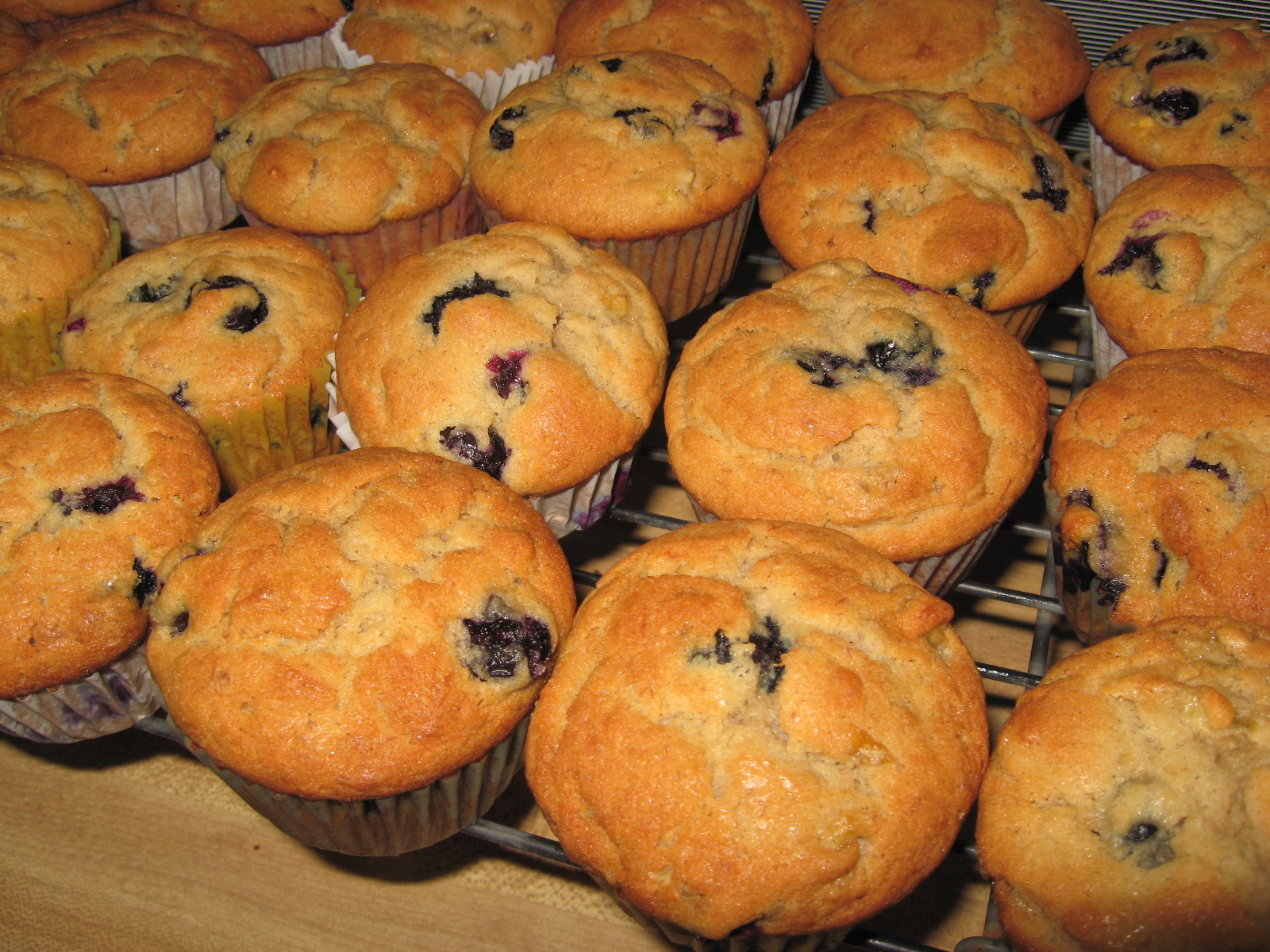
We've been enjoying this recipe since I found it in the March, 1987, Country Living magazine where it was called "Sour Cream Blueberry Bread."  It truly is a sweet bread recipe but because we always bake the batter in muffin tins, we call them muffins.

In the recipe below I noted changes I make in brackets after each ingredient.  (Abbreviations:  c./cup; tsp./teaspoon)

Banana Blueberry Muffins

Cream:
1 c. butter, softened [shortening works better]
3/4 c. sugar

Add:
2 large eggs
1 c. mashed, ripe bananas [or frozen, slightly thawed and mashed]
1/2 c. sour cream [we use low-fat or fat-free or sometimes drain yogurt to use]

Beat in just till smooth:
2 c. flour
1 tsp. baking soda
1/2 tsp. salt
1/2 tsp. cinnamon

Fold in:
1 c. fresh blueberries [or frozen if you don't have fresh]
1/2 c. coarsely chopped pecans [optional; we never use]

Bake in greased and floured loaf pan in 350-degree oven for about 60 minutes or until toothpick comes out clean.  Let cool completely in pan.

We bake them in 12 paper-lined muffin tins for 25-30 minutes or until a toothpick comes out clean.  Remove immediately from pans, let cool a few minutes, eat when they're cool enough.

Enjoy!

--Nancy.
.

Friday, May 3, 2013

Our Favorite Granola Recipe

Someone recently told me that everyone thinks their granola recipe is the best.  I've tried others and I have to disagree, but out of respect to others, I won't tell you that this is the best granola.  I will tell you, though, that this recipe is adaptable.  And is our favorite!

Heat together until combined:
1 c. oil
3 1/2 c. honey (18-20 oz.)

In a large bowl mix:
14 c. instant rolled oats (42-oz. canister)
3 c. sunflower seeds (~14 oz.)
1 1/3 c. toasted wheat germ (~11-12 oz.)
3 c. cashews (~18-20 oz.)
3 c. peanuts (~24 oz.)

Gently pour the warm oil/honey mixture over the dry ingredients and mix until the dry ingredients are completely coated.  It should be moist but not sticky.  If it's sticky, gradually add and mix in more of one of the ingredients.

Heat oven to 250 degrees.  Spread the granola over 4 large cookie sheets so that it's no deeper than 1-2".  Bake in oven for 1 hour.  Turn and bake another hour or until the granola drys out and looks light gold.  Remove from cookie sheets onto wax paper-covered newspapers and let cool.  Store in airtight containers.

The best way to eat this granola, in my opinion, is to put about half a cup of your favorite vanilla yogurt in a bowl, then coat it with just as much granola.  Yes, I know.   Someone once told me that this is just a convenient way of having dessert for breakfast.  That may be so, but it's healthy, filling, and delicious.  Comfort food, really.  (My husband's opinion is that it's best with milk.)

About the adaptability part:  If you happen not to like cashews, you can substitute almonds or walnuts or pecans or any other nut, as long as you substitute by measure, not by weight.  You can use fewer peanuts and more cashews, or more peanuts and fewer cashews, or more oats and less of something else.  You can cut the recipe in half, though I wouldn't recommend doubling it because it already makes such a huge quantity. 

This is an expensive recipe to make with the price of nuts so high:  we consider it an extravagant treat when we make it these days and enjoy every morsel.

If you have questions, please leave a comment and I'll respond.

Enjoy!

--Nancy.

Copyright ©2013-2018, Nancy Messier.  All Rights Reserved. 
Do not copy or use any content from this blog without written permission from the owner. 
.

Friday, April 26, 2013

Mixed Pickle, Sweet Pickel - Gramma's Webster's Recipe Book - Family Recipe Friday

Someone commented on last week's recipe post that generations ago cooks kept a lot of information in their heads.  It seems they didn't require the details provided by today's recipes as many modern cooks do.  Was it because there were fewer options for ingredients and cooking methods?  Maybe recipes didn't have such individual, specific needs or, if they did, perhaps they were learned at the side of a mother or sister, using the same recipe of ingredients often enough that the recipe became rote.  Was it because times were simpler?  I doubt they had a constant tide of new information assailing them on an hourly basis so perhaps it was easier to focus.  Whatever the reason, I sometimes stumble to decide how to mix and bake the old recipes.

Mixed pickle
5 qt.  [bracketed to left of first 3 lines]
1 quart small cucumbers
1    "   small onions   green tomato
1    "    cauliflower   (peppers)
sprinkle with salt
and let stand over
night
2 quart vinegar when
boiling add 8 tablsepoon
mustard.  3 cup sugar
1 1/2 cup flour
1 teaspoon cayenn pepper
1 tablespoon tumeric
boil in weak vinegar
10 min put in paste [?]
and boil. then seal.
while hot

Sweet pickel
For Pear, peaches, or apple
1 qt vinegar, 3 lb. sugar
1/2 ounce each whole cloves
and stick cinnamon
Boil fruit remove and
Boil syrup until clear
put in fruit & seal.

It looks like Gramma adapted the Mixed pickle recipe over time adding green tomatoes and peppers to the other ingredients.  I was surprised to see flour in the ingredients for pickles and also surprised at the quantity of spices.  I have a tender palette:  my husband teases me that I think catsup is spicy.  I'm not sure how well I'd enjoy these pickles with their cayenne and tumeric.

She doesn't mention the quantity of ingredients for the sweet pickle recipe.  Three pounds of sugar seems like a lot, but then they <i>are</i> sweet pickles.  I also find it interesting that she gave the weight of the spices instead of spoonful measurements.  The other recipes I've transcribed call for spoonful measurements.  I think this recipe may be the most challenging yet.

Gramma probably used Ball or Mason canning jars (as opposed to crocks or metal cans).  She didn't mention how long to boil the pickles.  These days each food being canned has a recommended processing time in a water bath or pressure canner for the food to be considered safely canned.  I doubt much detail existed during Gramma's time.  However, I don't know of a single family member who was harmed by her canning methods or those of any other family member.

The grandmother to whom these recipes belonged was Emma Virginia Bickerstaff Meinzen.

Happy canning (when canning season finally arrives)!
--Nancy.
.

Friday, April 19, 2013

Dip, Molasses Cake - from Gramma's Webster's Recipe Book - Family Recipe Friday

Here's another page from my grandmother Emma (Bickerstaff) Meinzen's Webster's Spelling Recipe Book.  The patent number date is 14, 1909, so we know Gramma wrote the recipes after that.  In 1909 she was 16, but the handwriting looks like it's written with a mature hand.  I have no doubt that she used these recipes:  they are spotted and dotted with ingredients that missed the bowl!  If you'd like to see the other recipes from her book, click on recipes under the Post Topics at the bottom of the page and a list will appear.

The dip recipe is a sweet one, probably used for fresh fruit, or possibly for cakes or cookies at parties or on special occasions.  I don't ever remember my grandmother making or serving it.

The order of ingredients for the Molasses Cake, which sounds quite a lot like gingerbread, seems unusual to me.  Commonly, cake batter is mixed with sugar and eggs first, then other liquid ingredients, with dry ingredients last (unless liquid and dry ingredients are alternated).  It's also hard to tell what's to be mixed together from the way this recipe's written.  The spices could easily be mixed in either the flour or the molasses.  I think the lard and soda go into 1 cup of hot water.   Cakes are usually baked in a 350-degree oven for anywhere from 20 minutes to 45 or 50 minutes.  Use a toothpick to test for doneness:  stick it in the cake, if it comes our clean, the cake is done; if it comes out with moist cake ingredients on it, bake a little longer.

Dip.
1 tablespoon corn Starch
1     "      "     flour.
1/2 to 3/4 cup Sugar, --
               or to taste.
Butter size of egg.
Pour on Boiling
Water to make
thick enough.
Nutmeg or Vanilla


Molasses Cake.
2 cups flour.
1 cup molasses.
mixed together.
1 tablespoon cinnamon
1/2 teaspoon nutmeg
1       "          cloves.
1 table spoon lard
1 teaspoon of Soda
Cup in Hot Water
Pinch Salt.
1 egg beaten last.


Enjoy!
--Nancy.
.

Related Posts Plugin for WordPress, Blogger...